
Famous inventors
Richard Arkwright
Sir Richard Arkwright (1732–92) was an English inventor and businessman. In the 1760s he became interested in finding ways of mechanizing cloth-making as a means to make his fortune. He invented the spinning frame, which he patented in 1769. A later version powered by running water was called the water frame. This machine allowed cotton to be spun into yarn (thread) on an industrial scale. It was a significant improvement on the spinning jenny, invented by James Hargreaves in 1764, and made a huge contribution to the Industrial Revolution.


Spinning frame
Arkwright decided to develop a machine that would improve on the spinning jenny. Teaming up with the clockmaker, John Kay, Arkwright's machine replaced the workers that were still required to operate the jenny. First demonstrated in 1768, the spinning frame, as it was called, was able to drive 128 spindles at a time, and the thread it produced was stronger.
First spinning mill
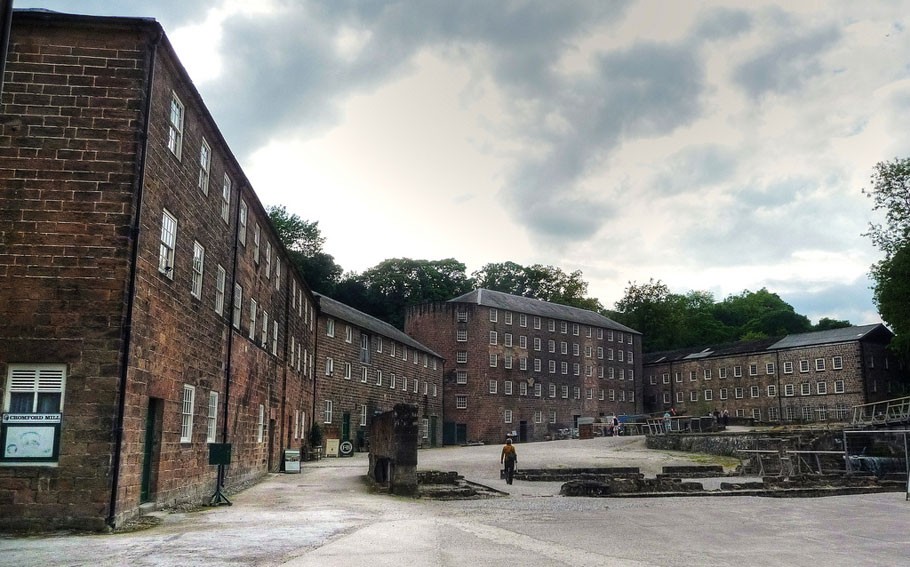
Too large to be hand-operated, Arkwright's frame needed a source of power to run it. Along with his new business partners Jedediah Strutt and Samuel Need, he decided to harness the power of the water wheel, previously used for grinding grain and in papermaking. In 1771 Arkwright installed the machine in a purpose-built mill on the banks of the River Derwent in Cromford, Derbyshire. He still needed a workforce, so he had a number of cottages built close to the mill, and this workers came to work there, rather than in their own homes. Arkwright's mill was the first modern factory.
Later developments
Arkwright opened more mills and, in 1775, introduced improvements to the carding (combing) process, by adapting a machine already invented by Lewis Paul in 1748. With his new carding engine, the whole process of manufacturing yarn could be now carried out by a single machine. Arkwright was the first to use James Watt's steam engine in textile manufacture, although initially it was used to pump water towards the waterwheel.


Spinning mule
A machine to spin cotton and other fibres, called the spinning mule, was invented between 1775 and 1779 by English inventor Samuel Crompton (1753–1827). It combined parts of the mechanisms from both Arkwright's spinning frame and Hargreaves' spinning jenny, enabling thread to be spun better than could be done by hand. It was used to manufacture muslin, a fine cotton fabric.
Crompton was unable to afford to patent his invention, with the result that other manufacturers were able to copy it freely. The spinning mule became the standard machine in the textile industry from 1790 until the 20th century, with many thousands operating in Britain alone.

Consultant: Dave Hawksett