
Environment

CITE
We have made every effort to follow citation style rules, but there may be some minor differences. If in doubt, please refer to the appropriate citation style manual.
Landmine contamination. (2026). In Q-files Encyclopedia, Geography, Environment. Retrieved from
https://www.q-files.com/geography/environment/landmine-contamination
"Landmine contamination." Geography, Environment, Q-files Encyclopedia, 23 Jul. 2026.
https://www.q-files.com/geography/environment/landmine-contamination.
Accessed 6 Aug. 2026.
Landmine contamination 2026. Geography, Environment. Retrieved 6 August 2026, from
https://www.q-files.com/geography/environment/landmine-contamination
Geography, Environment, s.v. "Landmine contamination," accessed August 6, 2026.
https://www.q-files.com/geography/environment/landmine-contamination


Landmine contamination
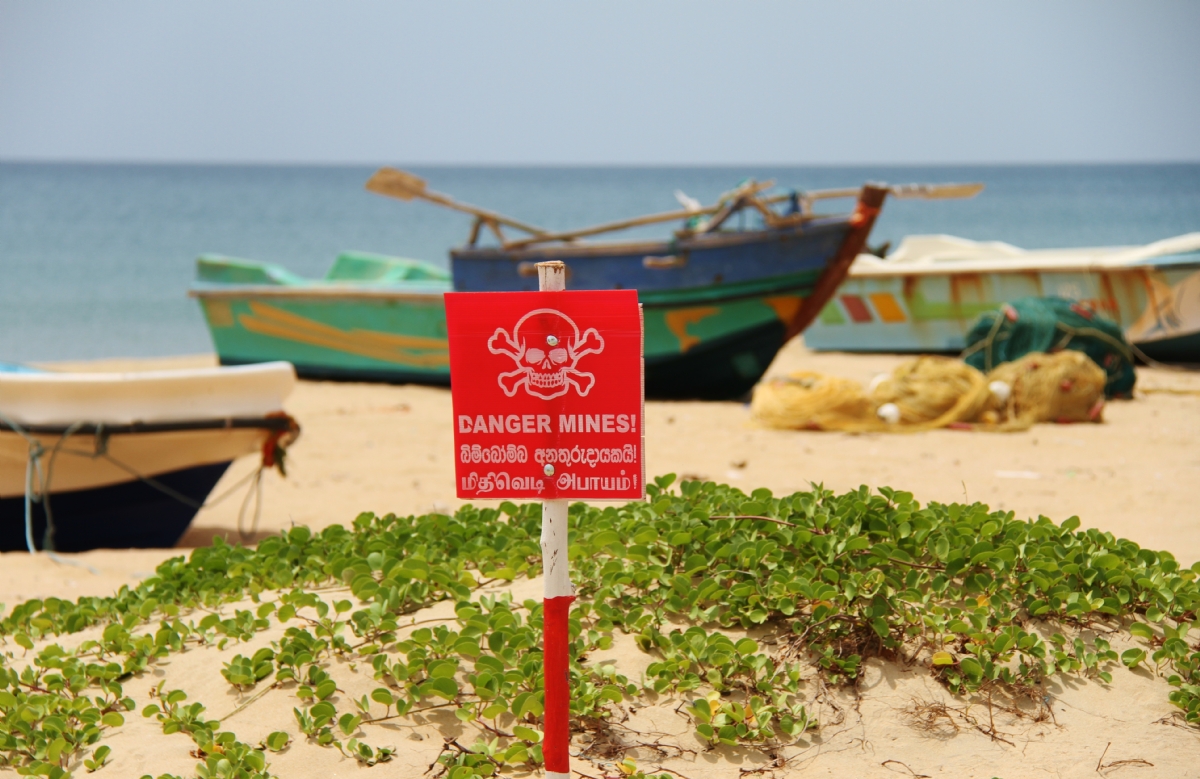
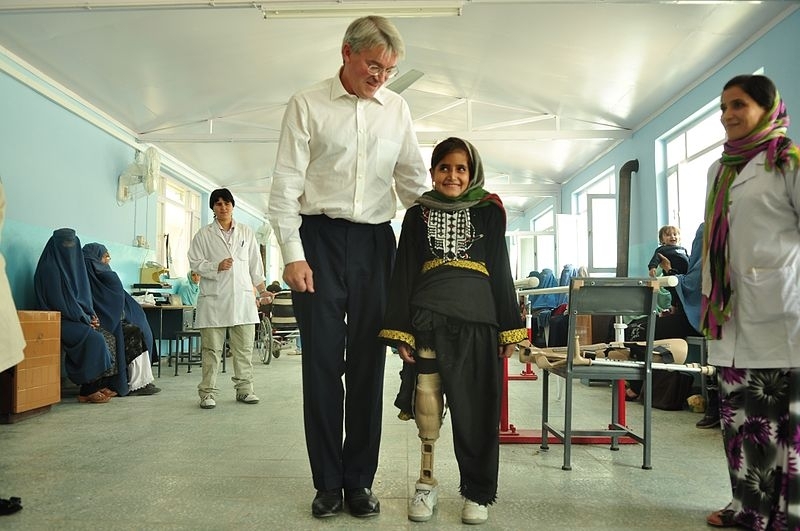
There are 78 countries in the world that are "contaminated" with landmines—explosive devices buried in the ground during wartime. Up to 20,000 people are killed every year, while countless more are badly injured. Nearly half of the victims are children, 84% of them boys. Anti-personnel mines detonate easily: all it takes is for a small child to step on one. Mines were first used in World War I, but they became particularly widely used in conflicts around the world from the 1960s onwards. Troops lay anti-personnel mines in minefields as a defensive barrier against enemy attacks. The problem is that, years after conflicts have ended, many landmines remain in the ground. Because their exact positions are not known, they pose a serious threat to the safety of people who live there. The minefields also cannot be used for growing crops or raising livestock.
Landmines
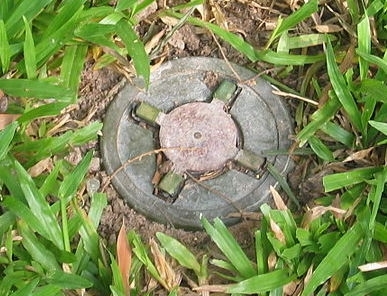
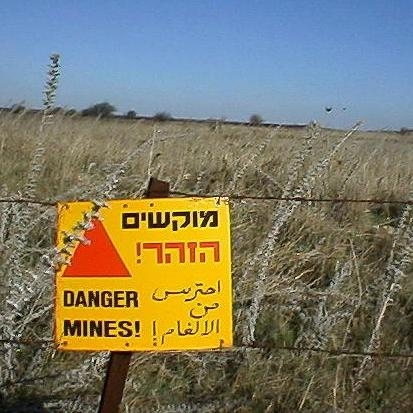
A landmine is an explosive device placed on the ground and hidden by leaves or rocks, or buried just under the soil. It is detonated automatically by when someone steps on it or drives over it. There are two main types: anti-tank mines, designed to blow up heavy vehicles, and anti-personnel landmines, which are designed to inflict serious injuries on people.
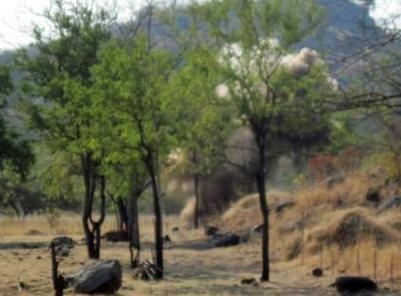
When a person steps on a mine and activates it, the mine's main charge detonates, creating a blast of hot gases travelling at high speed. Many types of landmine are fitted with anti-handling devices. These detonate the mine if someone attempts to lift it or disarm it. For this reason, the standard procedure for clearing mines is to destroy them on site without attempting to lift them.

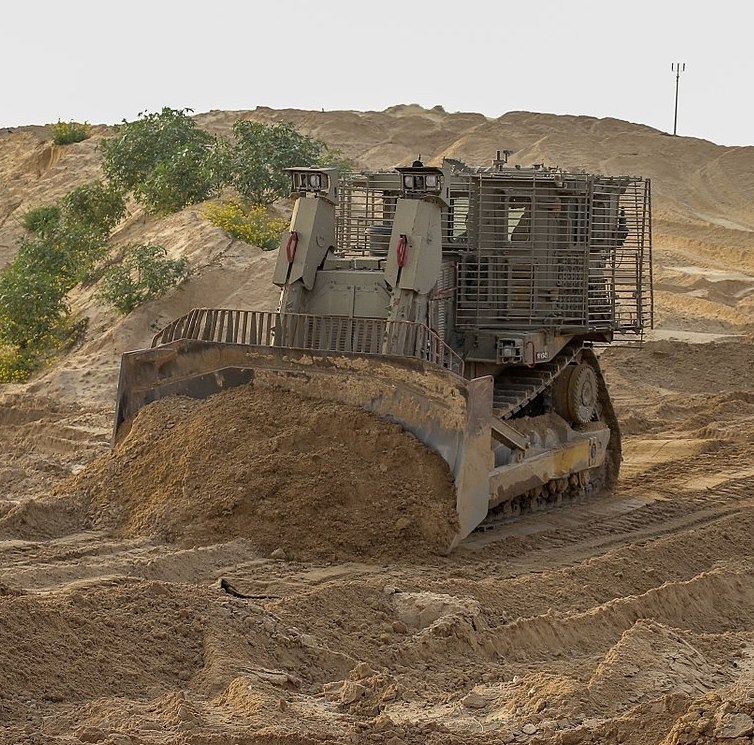
Demining
The process of clearing landmines is called demining. Nowadays this can be done quickly and safely using machinery. One of the latest is an excavator that digs up the soil then feeds it through a rock crusher, which is strong enough to withstand any exploding mines. Another machine, a soil sifter, uses a rotating sieving drum to extract objects—like landmines—of a certain size from the earth. Armoured steel and glass protect the operator from blasts.
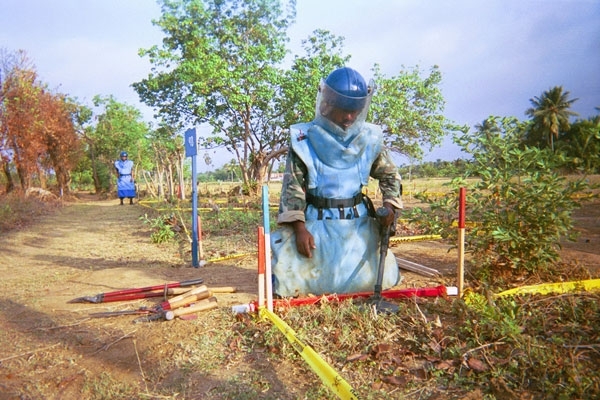
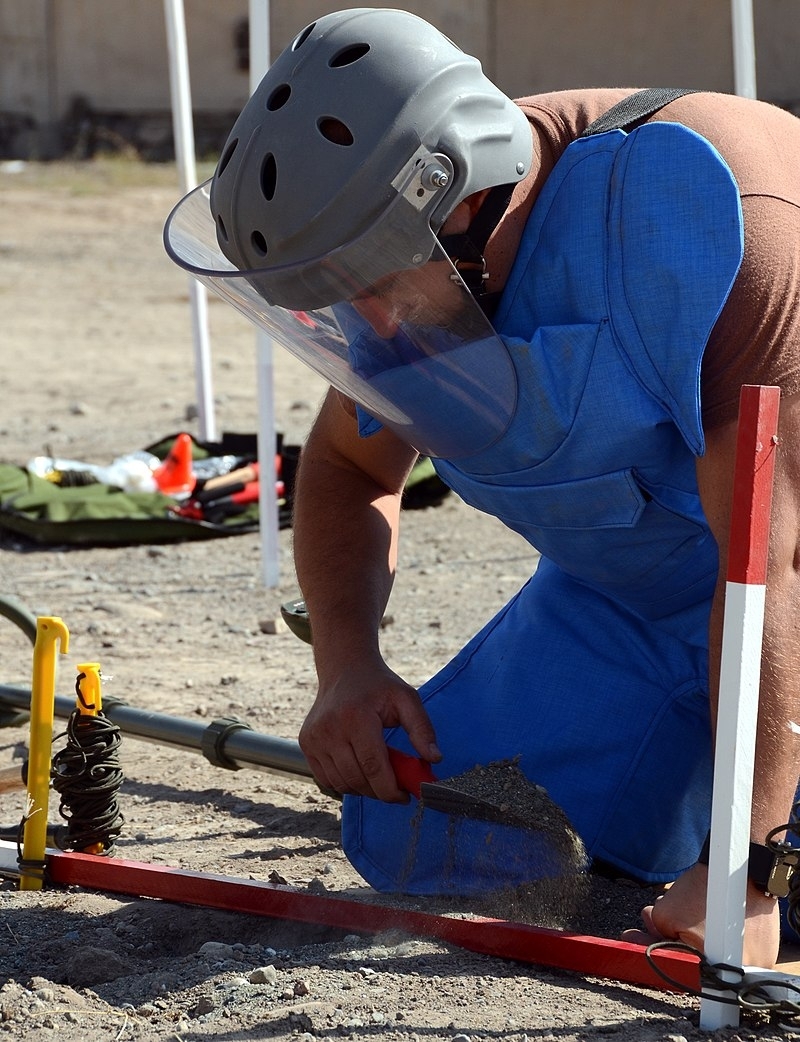
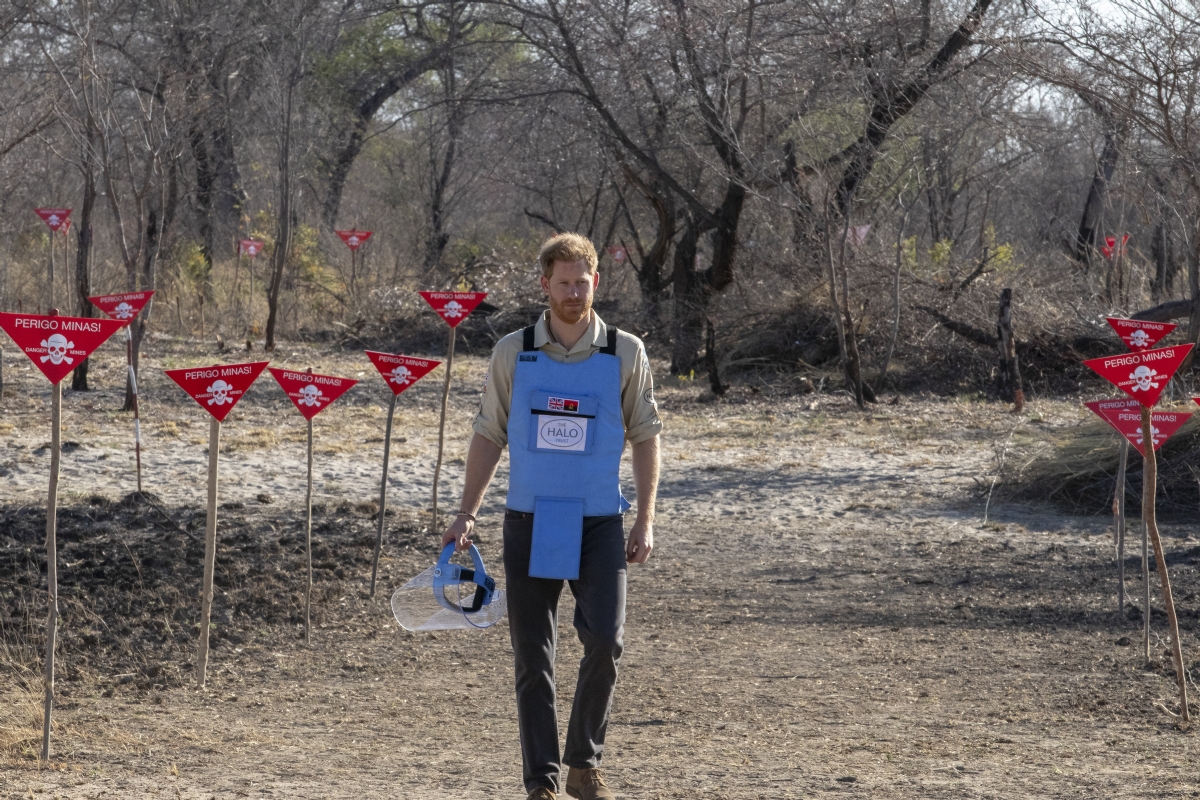
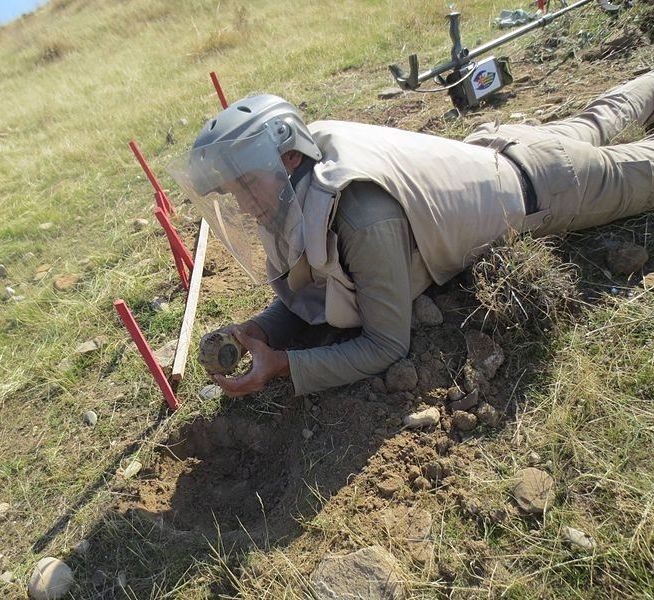
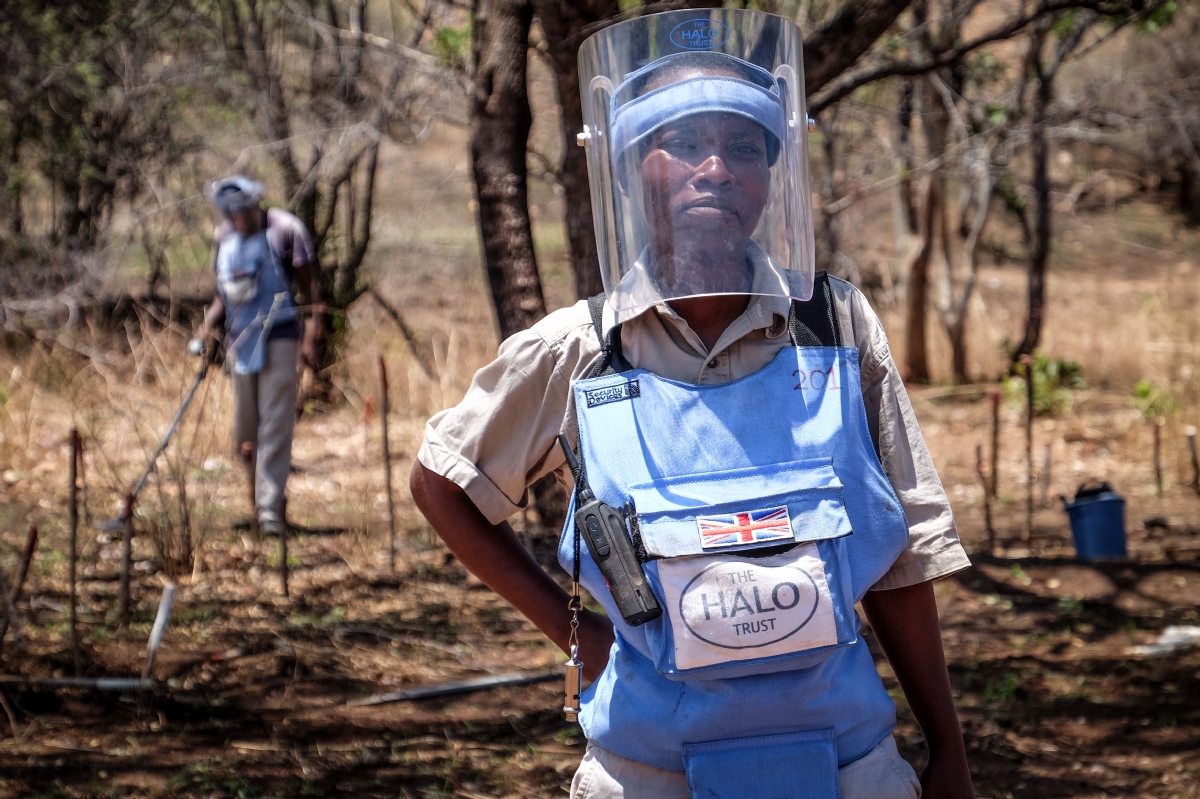
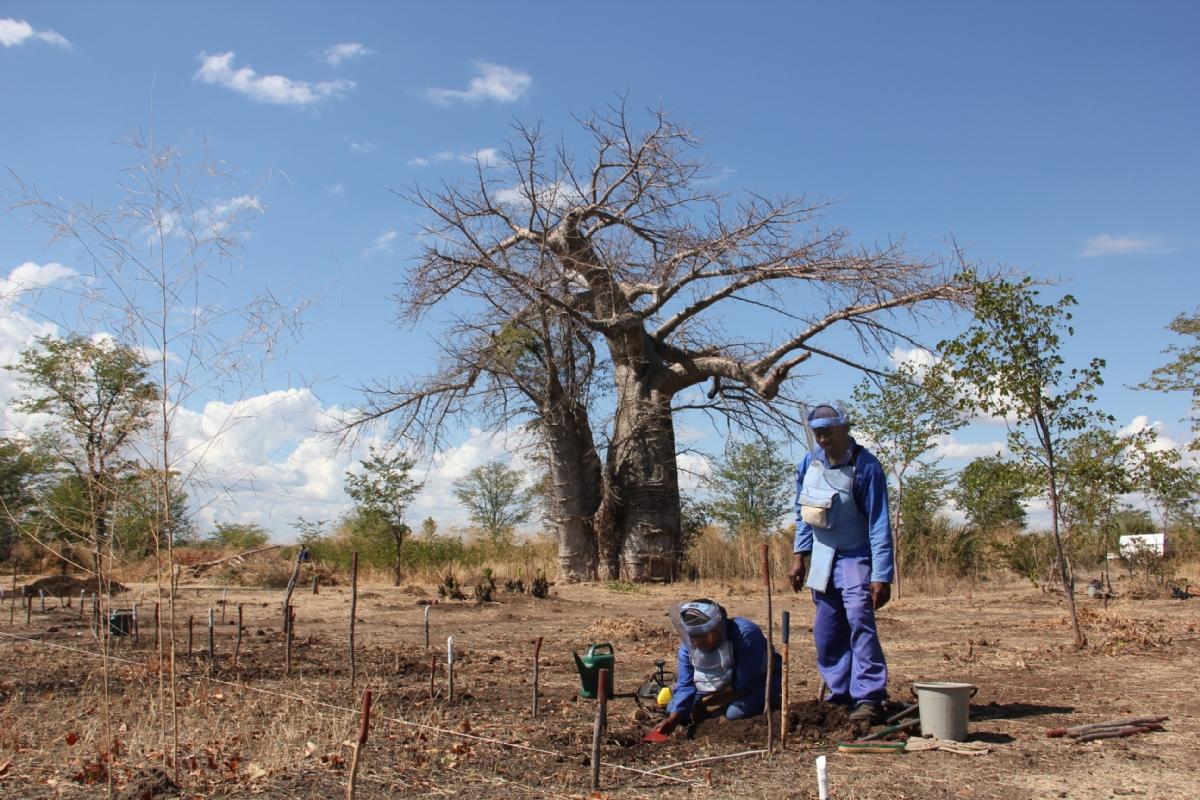
However, some areas are too remote or have terrain that is too rugged for such machines to be used. The mines must then be cleared manually by a team of deminers using metal detectors. Wearing blast-resistant Kevlar body armour and safety visors, the deminers work in two-person teams, each sharing the clearing process. Often, one carries out the search while the other watches and directs from a safe distance of at least 25 metres (90 feet). Every 30 minutes, when concentration inevitably starts to dip, the two swap places.
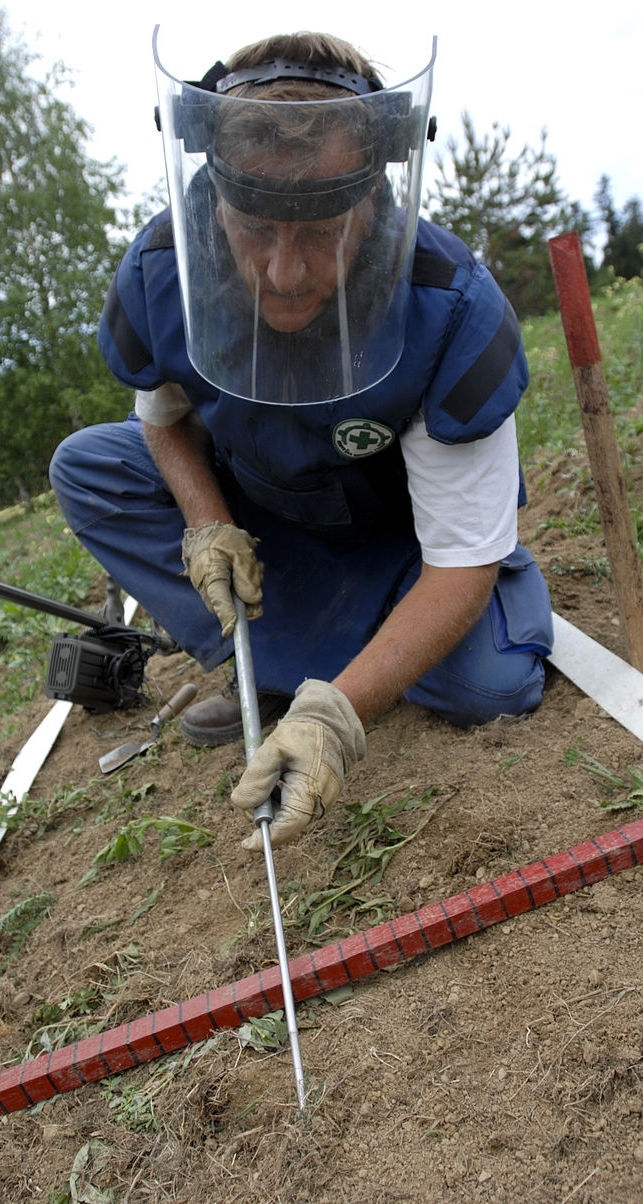
The deminers' first task is to mark where the safe ground ends. Any vegetation remaining at the start of the search lane is cut and the metal detector is panned slowly over the ground in a small rectangle of earth ahead of them marked out with red cord. The device sounds an alert when metal in the ground disturbs the magnetic field it generates. To examine a reading, the deminer uses a probe to feel under the ground for the side of a mine. The objects found are almost always harmless piece of junk such as cigarette packet foil or bottle tops. Painted sticks are planted in the ground to mark areas that have been cleared.
Animal mine-detectors
Another way to find the mines is to use animals. With their highly developed sense of smell, dogs can be trained to locate mines—even those buried below ground. If the dog detects the scent of explosives, it lies down, nose first, close to the target. After the spot is marked, deminers use metal detectors to pinpoint and unearth the device.
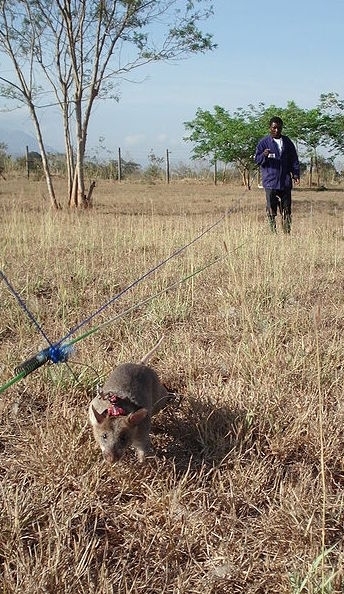
Rats are also trained to sniff out explosives. They can learn repetitive tasks and, being lighter than dogs, are less likely to set off mines. Reportedly, they can cover an area in a day that would take a metal detector two weeks. Already in use in Mozambique and Cambodia, "HeroRATS" as they are nicknamed, have been credited with clearing more than 100,000 mines.
In future, bacteria may be the answer. Mines emit gases as they degrade, which build up in the soil around them. Having been genetically engineered to detect the gases and become fluorescent in response, bacteria encased in tiny beads may be scattered over a minefield by a drone. If the beads light up, it means a mine lies beneath.
Ottawa Treaty
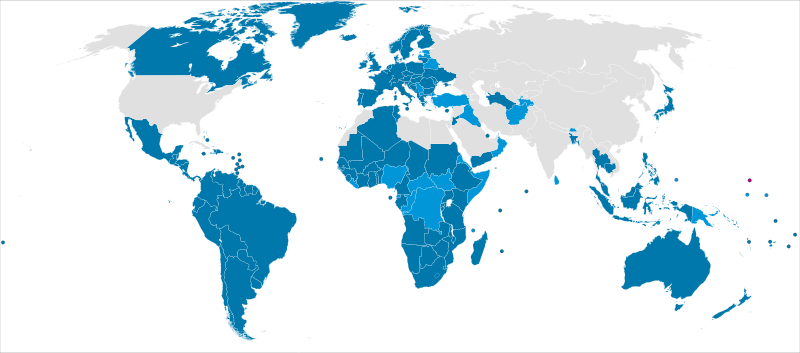
Formed in 1992, the International Campaign to Ban Landmines (ICBL) is a group of organizations whose objective is to free the world of anti-personnel mines. Diana, Princess of Wales, was a prominent supporter. The campaign led to the Mine Ban Treaty, in which all countries that sign up to the agreement pledge to prohibit the manufacture, use and stockpiling of landmines. It was signed by 133 nations in Ottawa, Canada, on 3rd December 1997. Since then, the number of parties to the agreement has risen to 165 (see map above: signatories, dark blue, others party to agreement, paler blue). They do not yet include the United States, Israel, Russia, China, Pakistan and India.
Many nations that signed the Ottawa Treaty have not yet complied with the 10-year deadline to clear minefields in their territory, nor the 4-year deadline to destroy stockpiles. The continuing use of anti-personnel mines has been reported in Myanmar (Burma), which has not signed up to the treaty, and Syria in its civil war. The jihadist terrorist group Boko Haram has been placing landmines in northeastern Nigeria since 2014.

The task of removal
Removing mines is a dangerous and expensive task. At current rates, it would be likely to take hundreds of years to get rid of them completely around the world. Countries with large areas still covered in mines include Angola, Afghanistan, Azerbaijan, Bosnia-Herzegovina, Cambodia, Chad, Colombia, Croatia, Iraq, Thailand, Turkey, Ukraine, Western Sahara and Yemen.
Thirty countries have been cleared of mines since 1997. By 2013, 75% of the mines in Afghanistan, Cambodia and Croatia were cleared. Mozambique was declared mine-free in 2015.
HALO
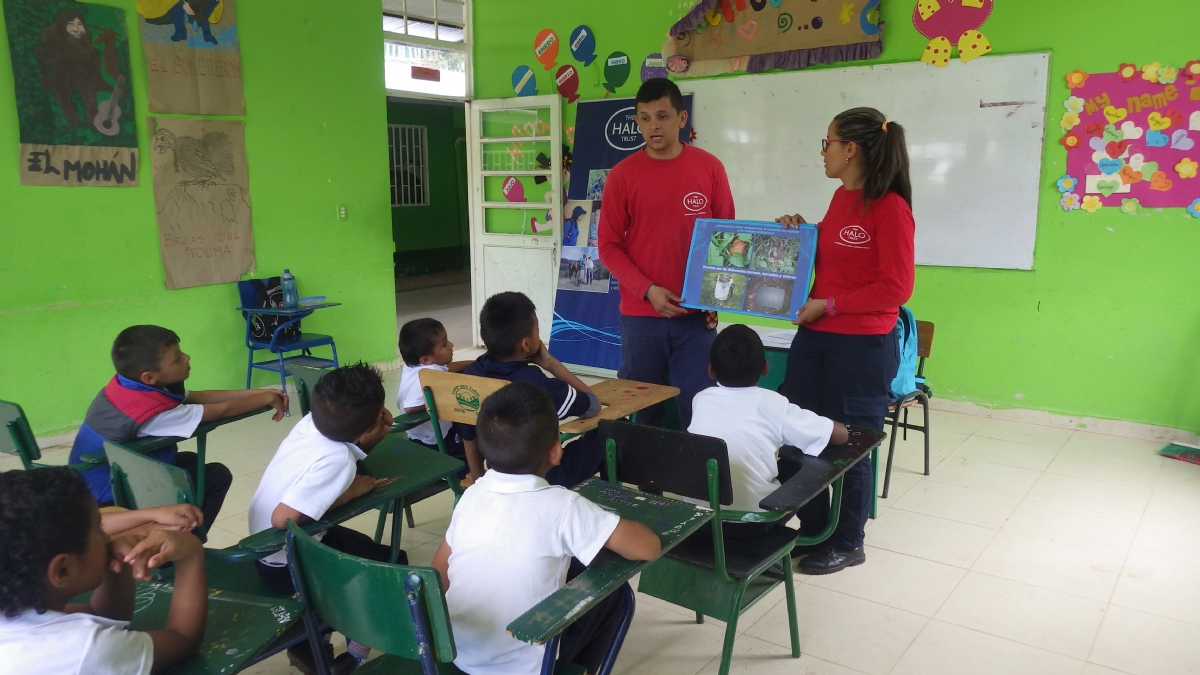
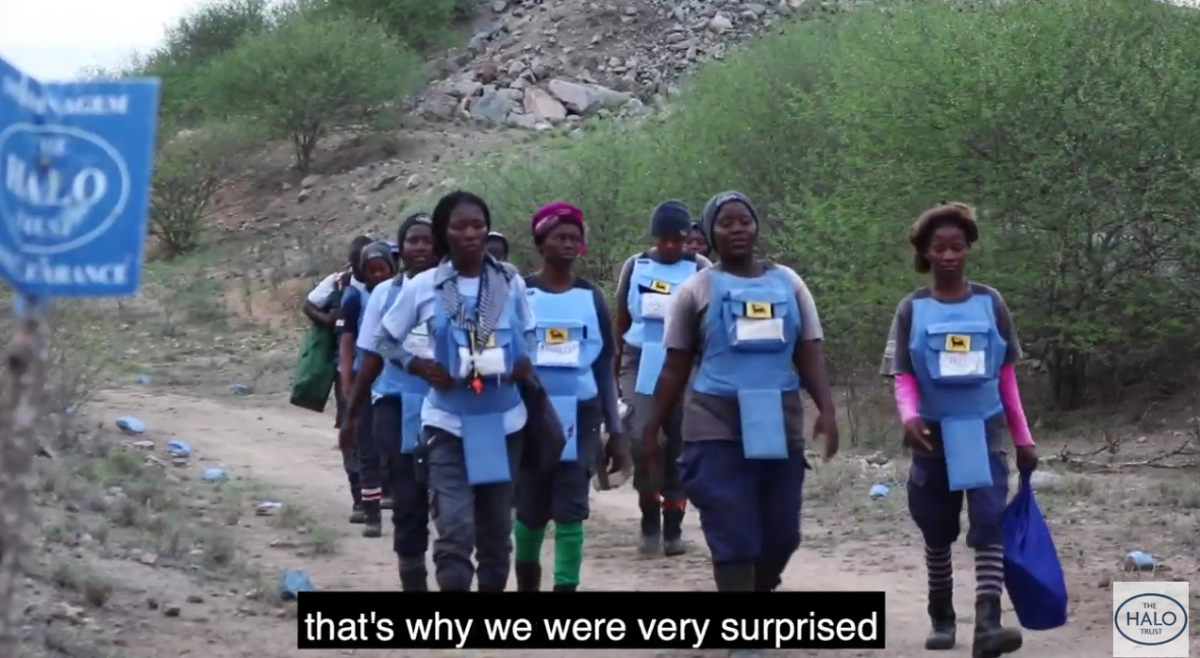
The HALO (Hazardous Area Life-support Organization) Trust was founded in Kabul, Afghanistan, in 1988, during the Afghan-Soviet Union conflict. The British charity now operates in 25 countries. Besides it principal objective of clearing landmines and explosives left behind after wars, HALO also runs education programmes, teaching people how to stay safe. It is also involved in destroying stockpiles of weapons. Most of the people who work for HALO come from the communities themselves: 400—including what will be a 100-strong group of women—are working to clear the landmines in Angola.
Angola
The government of Angola has recently signed an agreement with HALO that will enable it to clear 135 minefields in the Mavinga and Luengue-Luiana national parks. The headwaters of rivers flowing to the Okavango Delta in neighbouring Botswana rise in this region. Landmines make it almost impossible to protect the habitat here, so wildlife poaching is rife.
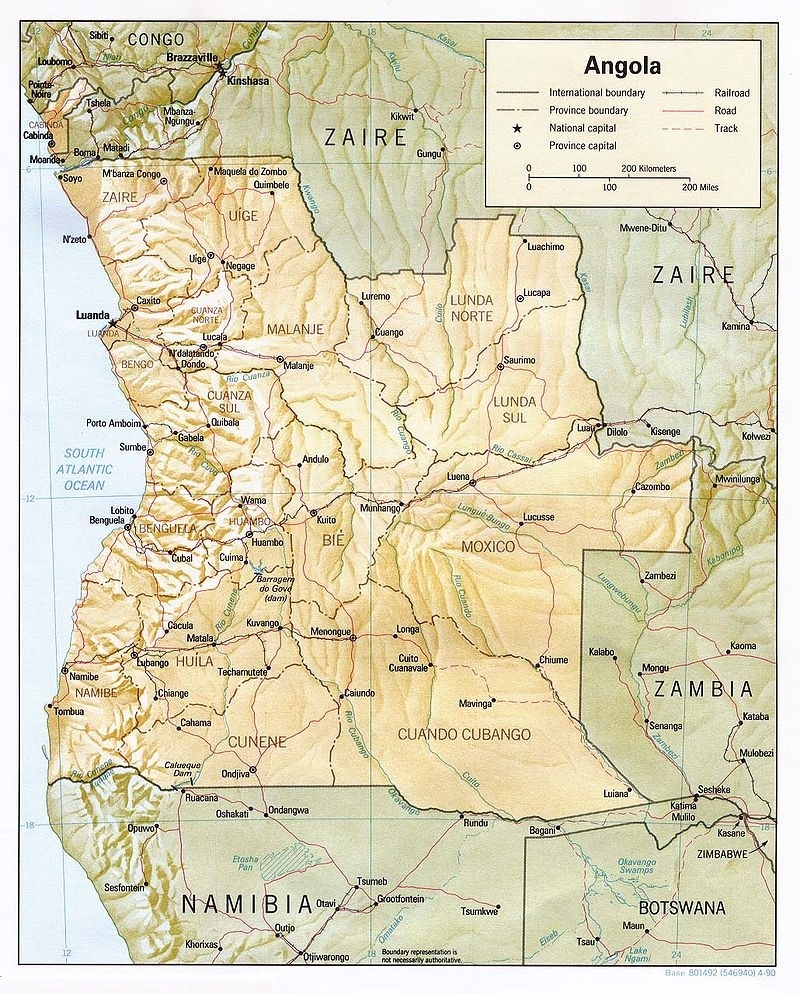
After Angola’s 27-year civil war ended in 2002, hundreds of thousands of landmines and explosives were left behind in fields, villages and towns, killing and injuring thousands of civilians (people not in the armed forces). In 2014, it was reported the number of people who had been injured by explosive devices left behind after the war had reached were 88,000 (the real total is probably higher). HALO says it is impossible to know exactly how many mines there are still in the country, but it has removed almost 100,000 devices since 1994. An estimated 1200 minefields remain, in which there may be up to half a million devices.
Visiting Cirico, Angola, in late September 2019, Prince Harry, son of King Charles III, made a plea for international support to help with a project to clear landmines from a region of southeastern Angola. He stood on the same spot where 22 years ago his mother, Diana, Princess of Wales, walked through a partially-cleared minefield, thus giving the global campaign to ban landmines a major boost. Diana's actions led to the 1997 Ottawa Treaty, which prohibits the use of anti-personnel landmines.
Consultant: The HALO trust
pics

Without in any way limiting Q-files Ltd’s exclusive rights under copyright, any use of this publication to “train” generative artificial intelligence (AI) technologies to generate text is expressly prohibited. Q-files Ltd reserves all rights to license use of this work for generative AI training and development of machine learning language models.