
Astronomy
Space probes
To study other bodies in the Solar System, even the most powerful telescopes are limited in what images and other information they can provide. Manned space missions to other planets are dangerous and expensive. Most other worlds in our Solar System have environments that are too hostile or too distant for humans to explore (a trip to Neptune, for example, would take several years). In order to gather detailed information about other planets and moons, a number of space probes—unmanned, remote-controlled spacecraft—have been launched instead. Equipped with cameras and sensing equipment, they can explore space and transmit information back to Earth much more cheaply and safely.
Updated 2nd June 2026


Missions
US spacecraft Mariner 2 became the first space probe successfully to reach another planet when it flew by Venus in December 1962. From a distance of 34,800 kilometres (21,600 miles), its detectors captured data from Venus’s surface.
The first space probe to make a successful soft landing on the Moon was the Soviet Luna 9 in 1966. It sent back TV pictures after its protective “petals” opened. The US space probe Pioneer 10 was the first probe to travel through the asteroid belt and fly by Jupiter. Launched in 1989, the Magellan space probe used radar to “see” through Venus’s thick atmosphere and make images of its surface.
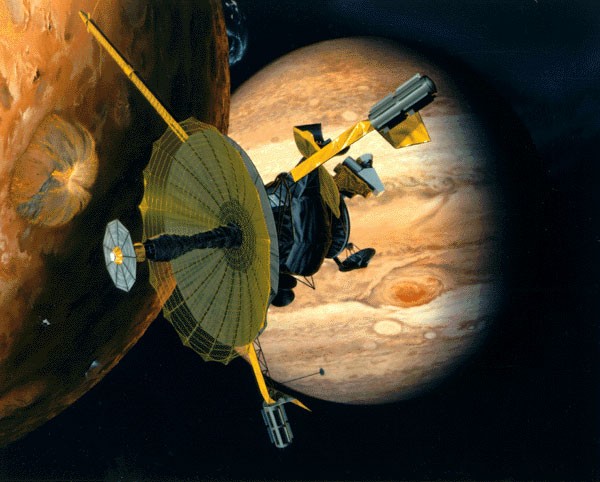
The Galileo space probe entered into orbit around Jupiter—the first probe to do so—in 1995. It carried a small descent probe, which it released into Jupiter’s atmosphere, from where it sent back data. Other detectors and cameras took images of Jupiter and its moons. In 2003 Galileo was deliberately destroyed by steering it into Jupiter's atmosphere. This eliminated the possibility of contaminating any of Jupiter's moons with bacteria from Earth.
Voyager
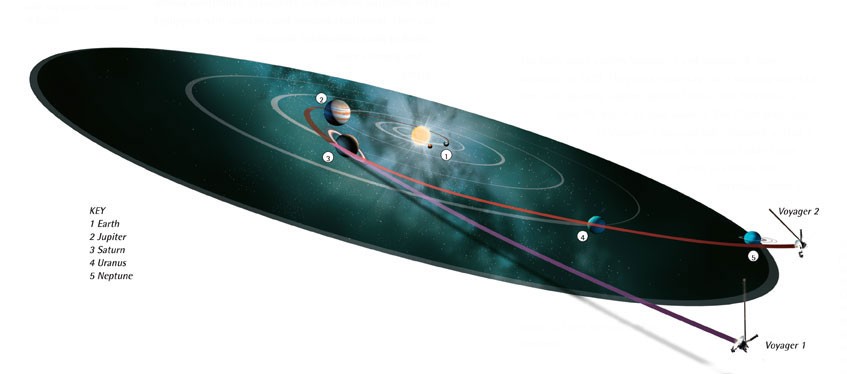
The twin space probes, Voyager 1 and Voyager 2, were launched in 1977. They took advantage of a rare alignment of the outer planets, Jupiter, Saturn, Uranus and Neptune, to make fly-bys of all four possible. The flight trajectory of Voyager 2 was carefully designed so that it could use the gravity field of each planet to provide the necessary force to change the speed and direction of the spacecraft to get it from one planet to the next.
Flying by the planets
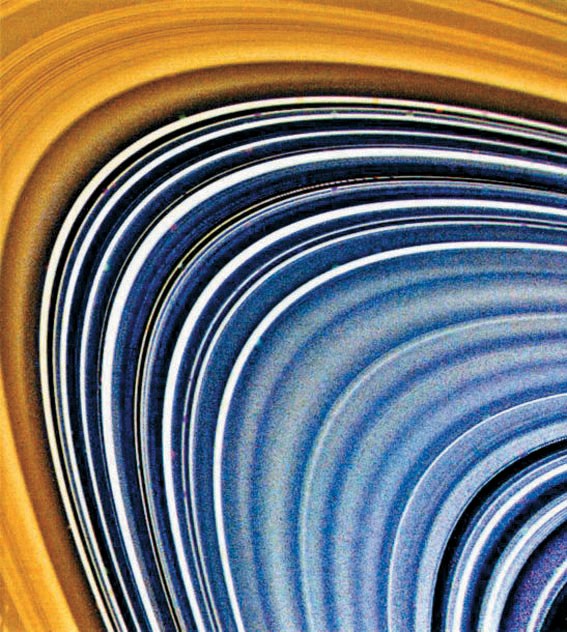
Although it took off slightly later than Voyager 2, Voyager 1 was the first to reach Jupiter in March 1979 and Saturn in November 1980. Both space probes took high-resolution images of the giants and their satellites, rings and moons. Voyager 2 flew by Uranus in January 1986 and Neptune in August 1989, sending back amazingly clear pictures of Neptune’s moon, Triton. From Neptune, Voyager’s signals took more than four hours to reach Earth. By the time they did so, they were 20 billion times less powerful than those of a watch battery.

Interstellar Mission
Their initial missions accomplished, both Voyagers are now travelling out of the Solar System: Voyager Interstellar Mission is underway. They have passed through the heliopause, the boundary beyond the reach of the solar wind, a stream of charged particles that flows from the Sun, and out beyond the heliosphere. Now, as of March 2026, at more than 25.8 billion kilometres (16 billion miles) from Earth, Voyager 1 is the most distant man-made object in the Universe. Both Voyagers continue to send back faint data, but since their nuclear power sources are gradually declining, they will stop sending signals probably before 2030.

Alien encounters
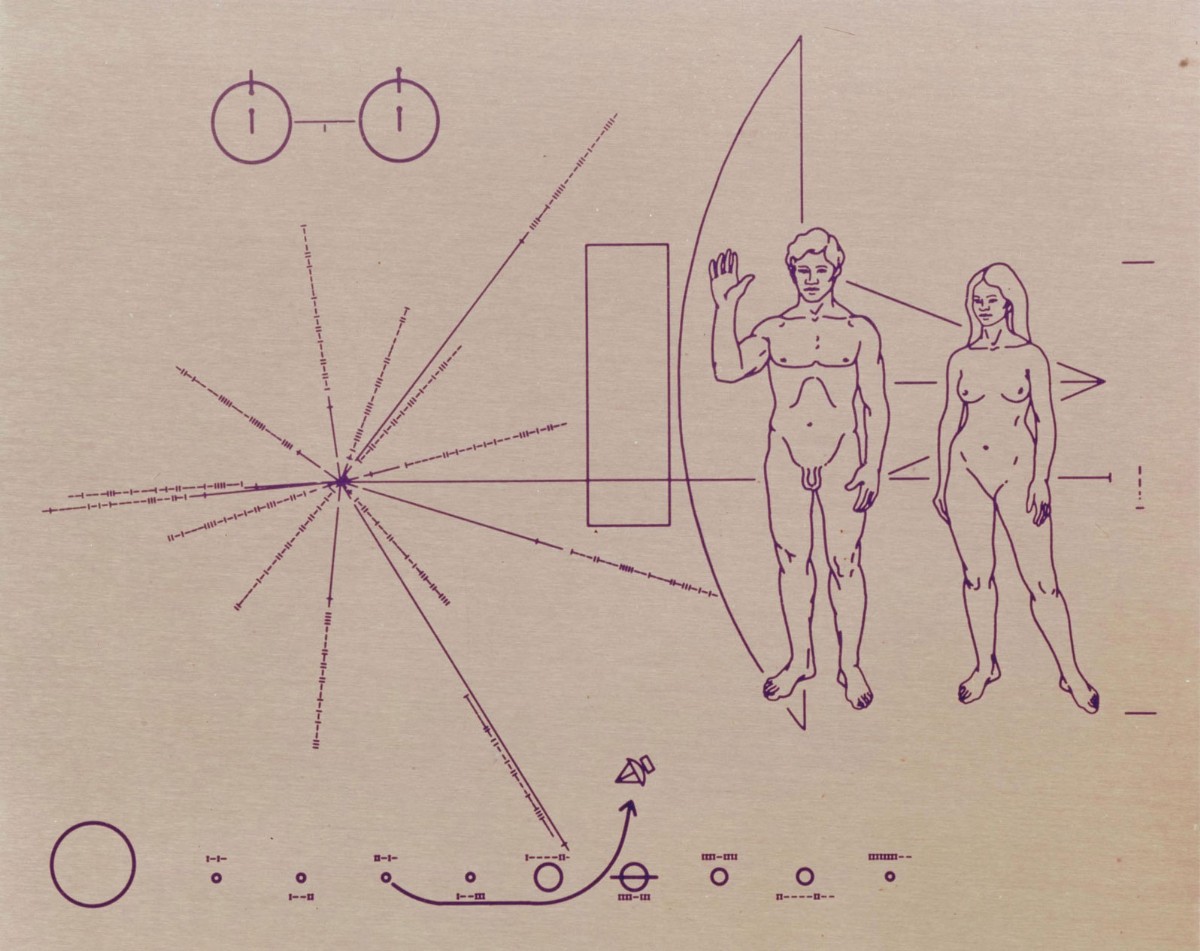
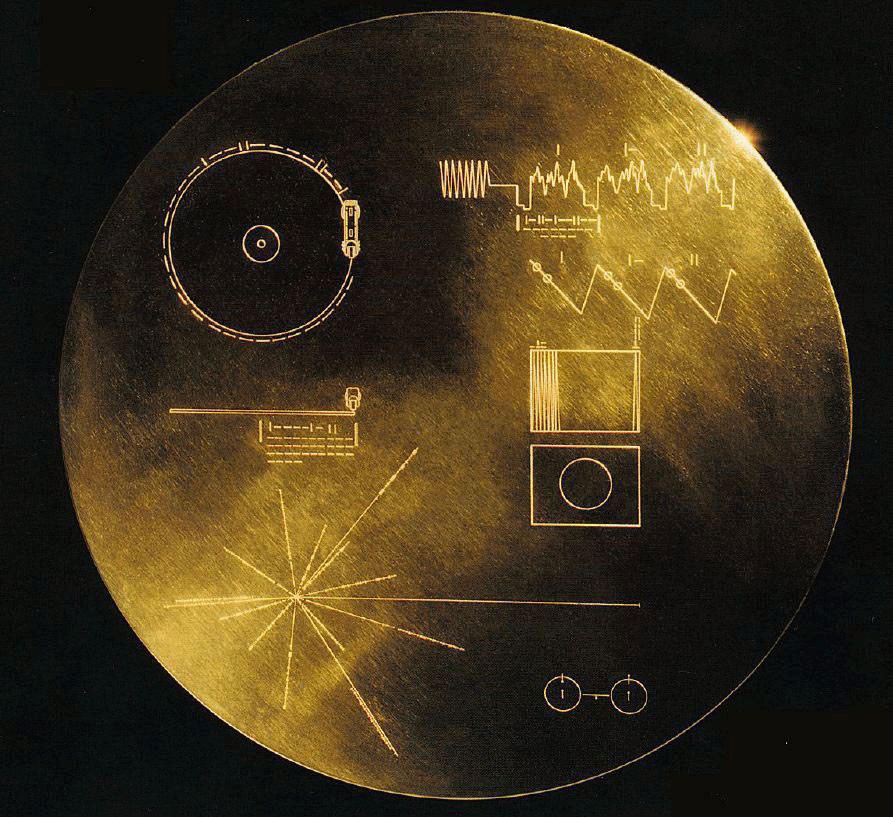
Both Pioneer and Voyager probes are heading out of the Solar System, although scientists can still remain in contact with the Voyagers. In case aliens should one day come across them, all four probes carry messages from Earth.
Pioneer 10 and 11 each have an engraved plaque with pictures of humans on it, and diagrams showing both Earth’s position in the Solar System, and the Sun's position in the Milky Way Galaxy. Voyager 1 and 2 both carry an audiovisual disc featuring "Sounds of Earth", which includes sounds of whales, a baby crying, music by Beethoven, Mozart and Chuck Berry, and greetings in 55 languages. There are also many pictures showing humans, animals, insects, plants and landscapes, as well as images of scientific interest.

Cassini
The Cassini space probe was launched in October 1997. Its objective was to study Saturn and its moons. Attached to the probe was the Huygens lander. It separated from the main craft and descended through the atmosphere of Saturn's moon Titan to land on its surface in January 2005. For 90 minutes it transmitted pictures and information back to Earth.
Cassini went on to perform a series of fly-bys of Saturn’s moon Enceladus. The images it took of the region surrounding the moon's south pole showed ice volcanoes erupting fountains of water vapour and tiny hailstones into space. Cassini was later steered low directly through one of these fountains, where it detected organic chemicals in the spray. Scientists suspect the presence of an ocean beneath the moon’s crust—and speculate on the possibility of life-forms existing in it.
Cassini’s mission ended on 15th September 2017, when it was deliberately steered into Saturn's atmosphere where it burned up. This was done in order to prevent any risk of contaminating Saturn's moons.
Mars missions
After the Moon, the next most likely target for a manned space mission is Mars. The Red Planet has already been the focus of some 71 space probe missions, of which about 40 have been at least partly successful. A number of fly-by probes, orbiters, landers and rovers have sent back images of the Martian surface. The first probes to land on Mars and complete their missions were the US Viking 1 and Viking 2 in 1976. Along with the first colour photos of the Martian surface, they sent back information that showed for the first time how Mars’s landscape had been sculpted by running water.


NASA’s Mars InSight probe touched down on the Elysium Planitia, a vast, smooth lava plain near Mars’s equator on 26th November 2018. InSight, which is short for Interior Exploration Using Seismic Investigations, Geodesy and Heat Transport, used its instruments to study the size and composition of the planet’s interior. Armed with this information, scientists hoped they would gain greater insight into how Mars formed 4.6 billion years ago.
Due to excessive dust on its solar panels preventing it from recharging, InSight was eventually unable to communicate with Earth and the mission ended in December 2022. In August 2024, analysis of data from InSight enabled researchers to discover a reservoir of liquid water at depths of between 10 and 20 kilometres (6–12 miles) under the Martian crust.
Mars rovers
The first rover, Sojourner, was carried by the Mars Pathfinder probe which landed in 1997. It was followed by the twin rovers Spirit and Opportunity, which landed in 2004. Contact with Spirit was lost in 2010, while Opportunity continued operating until February 2019. The Phoenix lander was the first to visit the north polar region of Mars, where it detected snow falling.

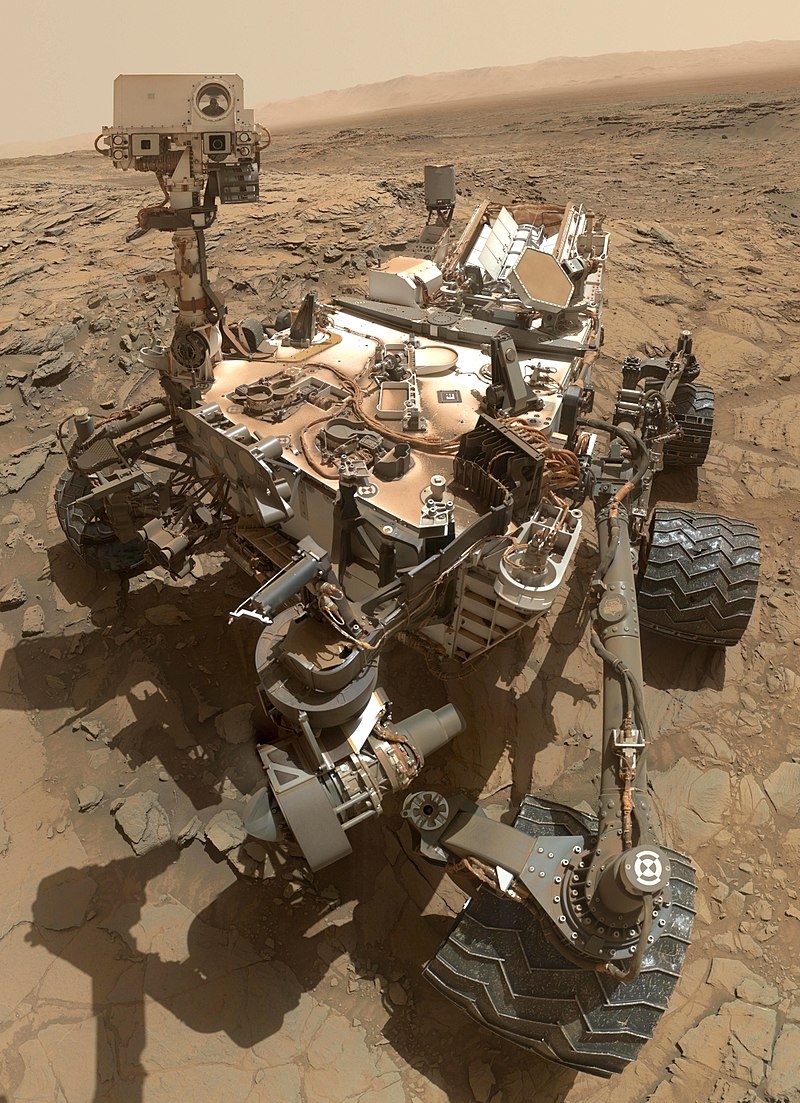
The Mars Space Laboratory, known as Curiosity, launched in 2011. One of its main objectives is to find out whether Mars is, or has ever been, capable of supporting microbial life. It successfully landed in Gale Crater on Mars on 6th August 2012. As of July 2025, Curiosity is still operational.
Curiosity discovered small droplets of salty liquid water contained within the rock samples it collected. It also found the elements sulphur, nitrogen, hydrogen, oxygen, phosphorus and carbon—all the necessary building blocks of life. In 2018, Curiosity detected complex organic molecules, including benzene, propane and butane, in layers of mudstone a few centimetres below the ground.
Perseverance, another rover of a similar design to Curiosity, was launched in 2020 and made its landing in Jezero Crater on 18th February 2021. It carries a drill and a mechanism to store rock samples which will be retrieved and returned to Earth on future missions. Perseverance's central aim is to determine whether life once existed on Mars. Unlike any previous mission to a moon or planet, it also transported a mini-helicopter, named Ingenuity, to Mars. This made its first successful flight—the first powered flight ever to take place on another world—on 19th April 2021.

Part of the Tianwen-1 mission to Mars conducted by the China National Space Administration (CNSA), the Zhurong rover landed on Mars on 14th May 2021. China thus became the second country after the US to soft-land a spacecraft on Mars successfully and establish communications from the planet's surface.

Mars orbiters
Mars Global Surveyor (MGS) went into Martian orbit in 1997. It studied the entire surface of Mars, sending images of gullies that indicate liquid water must have flowed on the surface in recent geological history. Mars Reconnaisance Orbiter took over from MGS in 2006. Its HiRISE camera can identify objects as small as dinner plates from 300 kilometres (200 miles) away. Other instruments can detect water and ice on or below the surface.
As of July 2025, Mars Reconnaisance Orbiter is still operational.
Rosetta and Philae
The space probe Rosetta was launched in March 2004. It reached Comet Churyumov–Gerasimenko (67P) in May 2014 and entered into orbit around the comet. In November, Rosetta released a small lander, called Philae, that descended on to the comet itself. It was intended that, on landing, two harpoons would fire into the comet's surface to prevent the lander from bouncing off. The harpoons failed to fire, but Philae still landed safely.

The first images of the comet's surface beamed back from Philae revealed a dramatic landscape of precipices, craters and boulders. Rosetta continued in orbit, carrying out a detailed study of Comet 67P. It detected water coming off the comet's surface. While the presence of water is no surprise to astronomers, data showed that the water contained about three times more deuterium—a heavy form of hydrogen—than water on Earth. On the 30th September 2016 the Rosetta probe was deliberately landed on to Comet 67P, finally ending its 12-year mission.

New Horizons
Nine years after it left Earth, NASA’s New Horizons space probe became, on Tuesday 14th July 2015, the first spacecraft to reach the dwarf planet Pluto, which is a member of the Kuiper Belt, a region of the outer Solar System where millions of tiny icy worlds orbit. The probe travelled first to Jupiter, whose gravity it used as a "slingshot" to increase its speed. For most of the rest of its voyage was spent in "hibernation mode" to preserve its on-board systems. In December 2014, New Horizons was brought back online for its encounter with Pluto. Coming within 12,500 kilometres (7800 miles) of the icy world, it took detailed images of both Pluto and its moon Charon as it zoomed past at 14 kilometres per second (30,000 mph). From the images taken by New Horizons, scientists now think a warm-water ocean may exist beneath the dwarf planet's crust.
Having completed its mission to Pluto, New Horizons' course was then set for a flyby of Arrokoth (also known as "Ultima Thule"), a much smaller Kuiper Belt object. This took place on 1st January 2019. The probe revealed the presence of water and organic molecules on the surface of Arrokoth, an object probably made up of two lumps of rock colliding during the formation of the Solar System.
Consultant: Mike Goldsmith