
Europe

CITE
We have made every effort to follow citation style rules, but there may be some minor differences. If in doubt, please refer to the appropriate citation style manual.
Spain. (2026). In Q-files Encyclopedia, Geography, Europe. Retrieved from
https://www.q-files.com/geography/europe/spain
"Spain." Geography, Europe, Q-files Encyclopedia, 31 Mar. 2026.
https://www.q-files.com/geography/europe/spain.
Accessed 13 Sep. 2026.
Spain 2026. Geography, Europe. Retrieved 13 September 2026, from
https://www.q-files.com/geography/europe/spain
Geography, Europe, s.v. "Spain," accessed September 13, 2026.
https://www.q-files.com/geography/europe/spain


Spain
Spain shares the Iberian peninsula with Portugal. The Pyrenees mountain range forms a natural border with France. Off Spain's southern tip is the Strait of Gibraltar, where the Mediterranean Sea between Europe and Africa narrows to about 14 kilometres (9 miles). In the centre of Spain, there is a plateau called the Meseta. It is rimmed by mountain ranges, called sierras, and cut through by great rivers, including the Ebro, Tagus (Tajo), Duero and Guadiana. Spain also includes the Canary Islands, in the Atlantic Ocean, and two tiny enclaves, Ceuta and Melilla, on the North African coast.


Regions
Spain is ruled by a constitutional monarchy: the monarch's powers are restricted, while the country is effectively governed by a parliament with an elected prime minister. The country is organized into what is known as an Estado de las Autonomías ("State of Autonomies"). It is divided into 17 self-governing regions, each of which looks after its own public services, such as schools and hospitals. The regions are: Andalusia, Aragon, Asturias, Balearic Islands, Basque Country, Canary Islands, Cantabria, Castile and León, Castile-La Mancha, Catalonia, Madrid, Extremadura, Galicia, La Rioja, Navarra, Murcia and Valencia.

North and interior
The north of Spain is cooler and wetter than the south; its climate is affected by westerly winds that blow across the north of Spain from the Atlantic. The northwestern coast is so lush that it is sometimes called “Green Spain”. In the northeast are the lowlands of the Ebro river valley—and the country’s industrial heartland.


South
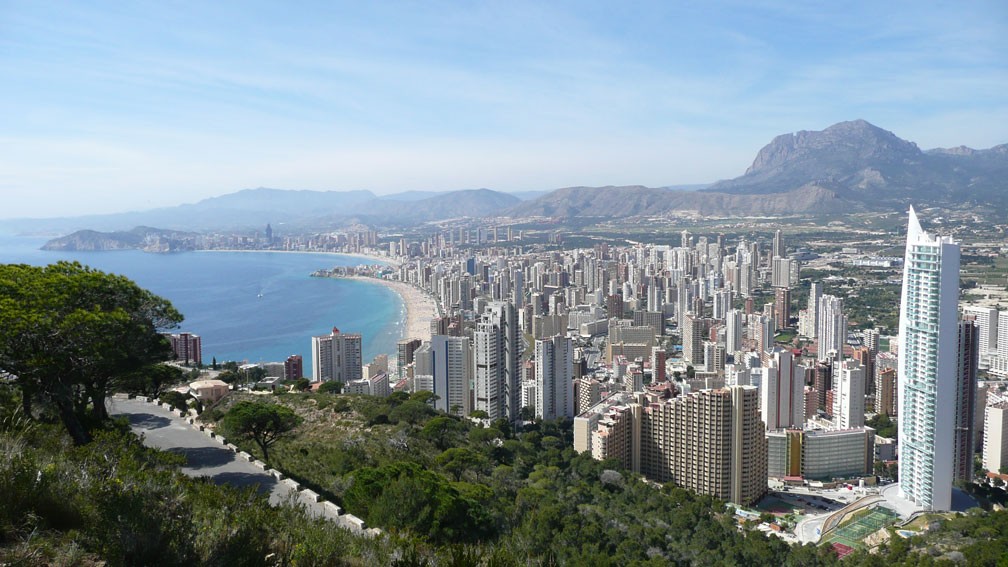
Farther south, across vineyards, wheat fields and olive groves, the climate becomes drier. The southern region of Spain is called Andalusia. Here, the River Guadalquivir winds across rich alluvial plains. The snow-covered Sierra Nevada mountains fringe the southern coast. Spain’s Mediterranean coast often experiences dusty breezes from Africa called siroccos. The weather is nearly always hot and sunny, and winters are very mild, making it extremely popular with overseas visitors. One in ten people in this region work in the tourist industry.


Economy
Spain’s economy is one of the largest in the world. Much of its industry is concentrated in the northeast, especially in Catalonia. Its main manufacturing industries are cars and trucks, textiles, machinery and pharmaceuticals. Spain is a leader in high-speed rail technology, known as Alta Velocidad Española (AVE). As of 2025, Spain has the second longest high-speed network (3973 km or 2469 miles) in the world after China.
Spain is also a major producer of renewable energy. In 2013, it became the first country in the world to use wind power as its main energy source. Tourism is also very important, especially in the south. The sunny climate, resorts and historic architecture attract over 90 million tourists every year. In 2024, Spain was the second most-visited country in the world after France.

Most Spaniards work in services, such as finance, education and healthcare. Spain’s economy suffered badly from the effects of the financial crisis, or “recession”, which hit Europe in 2008. At its lowest point, over a quarter of its workforce was unemployed. The rate for young people was even higher, at around 50%.

Farming
The mild, humid climate of Galicia in northwestern Spain is perfect for growing orchard fruits, such as apples and pears, as well as cereals and potatoes. Vineyards are found all over Spain, particularly on the south-facing slopes of its mountain ranges. In the south and along the Mediterranean coast, farmers grow fruits, vegetables and olives. A large part of the olive crop is pressed to make oil—Spain produces 45% of all the olive oil in the world. Large areas of Spain’s land are too hot, dry or mountainous to farm. Some areas have to be watered using expensive irrigation systems.


People
Most people in Spain are Roman Catholic and speak Spanish. The peoples of Galicia, Catalonia and the Basque Country speak their own languages. Many people in the Basque Country (Euskal Herria) and Catalonia (Catalunya) would like their regions to break away from Spain and become separate countries. For many years, an organization called Euskadi Ta Askatasuna (ETA) pursued a campaign, often violent, to gain independence for the Basque Country.
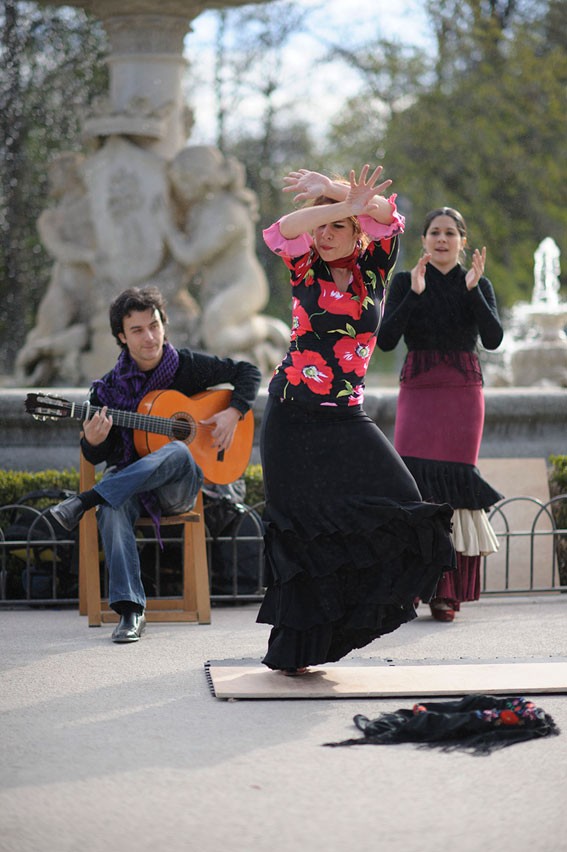
The most densely-populated areas of Spain are around the capital, Madrid, and along the eastern and southern coast. Eating and drinking with their families is very important to Spanish people. Communities often come together to celebrate religious festivals with music and dance. Dances, such as the flamenco from Andalusia and the sardana of Catalonia, are famous across the world.


Multicultural Spain
Nearly all Spanish people are descended from a mixture of Celts, Carthaginians, Romans, Visigoths and Moors—all the peoples who conquered and settled the Iberian peninsula over the course of its history. Spain is also home to one of the world’s largest populations of Roma people, known in Spain as gitanos. The Spanish Roma are the descendants of an ancient Indian people who first arrived in Spain in the 15th century; today, they number around one million.
In recent years, Spain has seen a huge increase in immigration. Between 2000 and 2010, only the USA took in more immigrants than Spain. Just over a tenth of Spain’s current population were born abroad. Morocco, Venezuela, Ecuador and Colombia. Others come from EU countries such as Romania and from West Africa.


Balearics
The Balearic Islands (Islas Baleares) are an archipelago situated in the Mediterranean Sea off Spain's eastern coast. The four largest islands are Majorca (Mallorca), Minorca (Menorca), Ibiza (Eivissa) and Formentera. Majorca, the largest, is made up of a central plain lying between mountains in the northwest and east. Its northern coast is rugged.
The Balearic islands have a Mediterranean climate and all the larger ones are popular tourist destinations. More than half the population works in the tourist industry. Both Catalan and Spanish are official languages in the islands.
Canary Islands
The Canary Islands (Islas Canarias) are a group of volcanic islands belonging to Spain, lying just off the southwestern coast of Morocco in the Atlantic Ocean. Many Canarians are descendants of the islands’ first settlers who arrived over 3000 years ago. Most Canarians live on the largest island, Tenerife. They grow bananas or tobacco, or work in construction and tourism. Over 16 million tourists visit the Canary Islands each year. They are drawn by the favourable year-round climate, along with natural attractions such as Gran Canaria’s vast sand dunes and Tenerife’s Mount Teide, the world’s third highest volcano.


Consultant: Nicholas Harris
Facts about Spain
Population 49,077,984 (2024 estimate)
Area 498,980 sq km
Highest point Pico de Teide (on Canary Islands) 3718 m (12,198 ft); Mulhacén 3779 m (11, 414 ft) (on mainland)
Capital Madrid, metro area population 6,791,667; city proper 3,255,944
Other major cities Barcelona (metro area pop. 5,687,000; city proper 1,621,537), Valencia (metro area pop. 2,522,383 city proper 814,208), Seville (703,206), Zaragoza (674,317), Málaga (568,305)
Languages Spanish, Catalan, Galician (Galego), Basque
Religions Christian (Roman Catholic) 94%, others and none 6%
Ethnicity Spanish 86%, others (including Latin American, North African and European) 14%
Currency Euro (EUR)
Chief exports machinery, motor vehicles, foods (olive oil, citrus, grapes and other fruits), wine, chemicals, medicines


History of Spain
8th century BC
Phoenicians arrive and name the land “Span”
500 BC
Celts from central Europe settle in Spain
206 BC
Romans expel Carthaginian rulers and take control of the Iberian Peninsula and name it Hispania. The Roman conquest is completed in 19 BC.
409 AD
Germanic tribes (Visigoths) arrive in Iberia, settling in the northwest (the modern province of Galicia) and northern Portugal. The Visigothic kingdom is established after the fall of the Western Roman Empire in 476, with Toledo the capital from 542.
8th–13th centuries
As Christians flee Muslim rule in the south, Christian armies begin fighting to take back Spain from Muslim forces in what is known as the Reconquista or “re-conquest”. The north of Spain becomes a Christian stronghold. Fighting continues between Christian and Muslim forces.
711–18
Forces of the Muslim Umayyad Caliphate cross into Spain from North Africa and conquer nearly all the Iberian Peninsula from the Visigoths. The Umayyads make Córdoba their capital.
722
Kingdom of Asturias is founded in northern Spain by Visigoths after they defeat the Umayyad army. It is annexed by the Kingdom of León in 924.
1085
Christian kingdoms capture Toledo from Muslim rule
1179
The kings of Castile and Aragon agree to work together to drive the Muslims out of Spain
1200s
Muslims are defeated by Castilian forces in Córdoba (1236) and Seville (1248), while Aragon captures Valencia (1238); the only Muslim region left is Granada, in southern Spain.
1469
Isabella I of Castile and Ferdinand II of Aragon marry, uniting Spain’s two Christian kingdoms
1479
Beginning of the Spanish Inquisition: non-Christians are considered enemies of the state; Spanish Jews and Muslims are forced to convert to Christianity
1492
Ferdinand and Isabella’s army recaptures the last remaining Muslim city, Granada, ending Muslim rule in Spain; Christopher Columbus’s Spanish-sponsored expedition lands in North America
16th–17th centuries
Spanish Golden Age: Spain is at the peak of its power and influence in Europe and the world. The era sees a flourishing of the arts in Spain.
1519
Charles I of Spain, of the Habsburg family, becomes Holy Roman Emperor. His vast empire now also includes (as well as Spain): Bohemia, Austria, the Low Countries, parts of Italy, and Spain's conquered lands in the Americas and Philippines.
1521
Spanish conquistador Hernán Cortés conquers the Aztec Empire for Spain.
1532
Spanish conquistador Francisco Pizarro begins conquest of Inca Empire for Spain (the conquest is completed in 1572).
1556
Charles V abdicates (gives up his throne) and splits his empire in half. His son Philip II governs Spain and the Spanish overseas colonies, Italy and the Netherlands, while his brother Ferdinand I governs the Habsburg territories in Germany and becomes Holy Roman Emperor.
1571
Spanish naval victory over the Ottoman Empire at the Battle of Lepanto
1580–1640
Iberian Union: union of the crowns of Spain and Portugal and their colonial empires. It formally ends in 1668 at the Treaty of Lisbon, following the Portuguese Restoration War (1640–68).
1588
The English navy defeats the mighty Spanish Armada (a fleet of Spanish ships) during the Anglo-Spanish War
1701–14
Following the War of the Spanish Succession, fought between France and the Grand Alliance (Habsburg Austria, the Dutch Republic and Britain), Philip V of the French House of Bourbon becomes King of Spain. Spain loses its European territories outside the Iberian Peninsula.
1808–14
Spanish War of Independence: French troops led by Napoleon invade Spain but are forced out by Spanish, British and Portuguese soldiers
1808–33
Spanish American wars of independence: all Spain’s American colonies (except Cuba and Puerto Rico) gain their independence.
1868
Glorious Revolution: Queen Isabella II is deposed; it is followed by the Sexenio Democrático (six democratic years) before the restoration of the monarchy with King Alfonso XII in 1874
1898
During war with the USA, Spain loses its remaining colonies in America—Cuba and Puerto Rico—as well as Guam and the Philippines.
1910s
Spain conquers Morocco and the Spanish Sahara in Africa
1914–18
Spain declares itself neutral during World War I
1931
Spanish people protest against the monarchy and declare a republic; King Alfonso XIII flees to Rome
1936–39
Spanish Civil War: the armed forces, led by General Francisco Franco, revolt against the newly-elected government. About 1 million Spaniards perish during three years of violence and fighting, in which Franco's rebels are supported by Germany and Italy. In 1939, Franco declares himself head of state and ends the war. He will rule as a dictator until his death in 1975.
1939–45
Spain declares itself neutral during World War II.
1959
A military group called the ETA forms and begins fighting for independence for the Basque region of northern Spain and southern France
1975
After the death of Franco, Juan Carlos, the grandson of Alfonso XIII, becomes king and sets up a democracy
1981
Rebels try to take over the government in a coup, but the plotters surrender after King Carlos intervenes
1986
Spain joins the European Economic Community (which will later become the European Union)
1997
ETA kidnaps and kills a Basque councillor, Miguel Angel Blanco; 6 million Spaniards protest in a national outrage
2002
Spain begins using the Euro as its currency
2004
191 people are killed in a number of terrorist attacks on Madrid’s trains by an Islamist group with links to al-Qaeda.
2012
Unemployment rate reaches 25% of the workforce; youth unemployment (under 25 year-olds) stands at over 50%
2014
King Carlos steps down and is succeeded by his son, Felipe VI
2006
Voters in Catalonia back proposals to give the region greater autonomy
2017
Basque militant group ETA effectively ends its armed separatist campaign after almost half a century
2017
(October) In a referendum held on 1st October (declared illegal by Spain's Constitutional Court) about 90% of Catalan voters back independence, although the turnout is only 43%; Spanish national police try to prevent people voting, causing clashes. Catalan parliament votes for independence on 27th October leading the Spanish Government to impose direct rule, sacking the Catalan leaders, dissolving parliament and calling regional elections
2019
(October) Violent protests, triggered by the sentencing of nine Catalan independence leaders by the Supreme Court of Spain, break out on the streets of Barcelona and other cities in Catalonia
2024
(October) Torrential rain caused by a cold drop (a pocket of cold air moving southwards into surrounding warm air) brings over a year's worth of precipitation to southeastern Spain, especially in the Valencia region. Severe flash flooding causes the deaths of 227 people, with 11 more missing and substantial damage to buildings. It is one of the deadliest natural disasters in Spanish history.
pics
Without in any way limiting Q-files Ltd’s exclusive rights under copyright, any use of this publication to “train” generative artificial intelligence (AI) technologies to generate text is expressly prohibited. Q-files Ltd reserves all rights to license use of this work for generative AI training and development of machine learning language models.