
Africa

CITE
We have made every effort to follow citation style rules, but there may be some minor differences. If in doubt, please refer to the appropriate citation style manual.
Cape Verde. (2026). In Q-files Encyclopedia, Geography, Africa. Retrieved from
https://www.q-files.com/geography/africa/cape-verde
"Cape Verde." Geography, Africa, Q-files Encyclopedia, 30 Mar. 2026.
https://www.q-files.com/geography/africa/cape-verde.
Accessed 22 Sep. 2026.
Cape Verde 2026. Geography, Africa. Retrieved 22 September 2026, from
https://www.q-files.com/geography/africa/cape-verde
Geography, Africa, s.v. "Cape Verde," accessed September 22, 2026.
https://www.q-files.com/geography/africa/cape-verde


Cape Verde
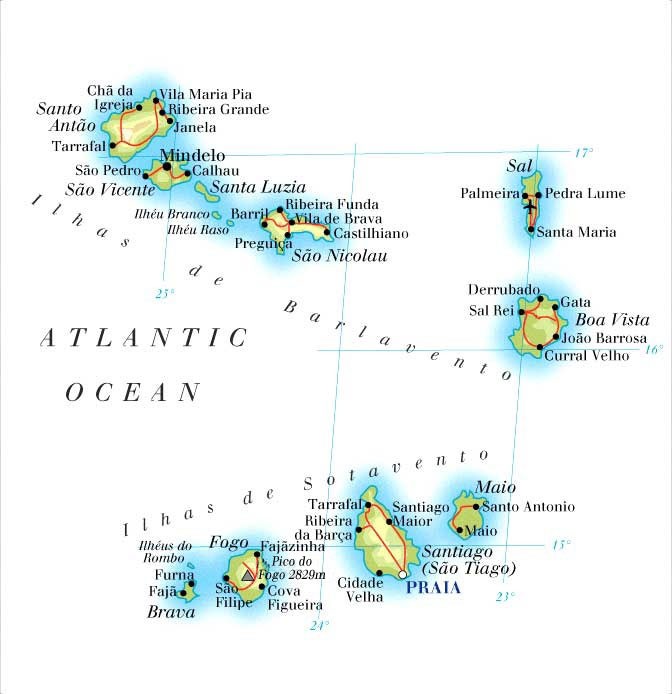
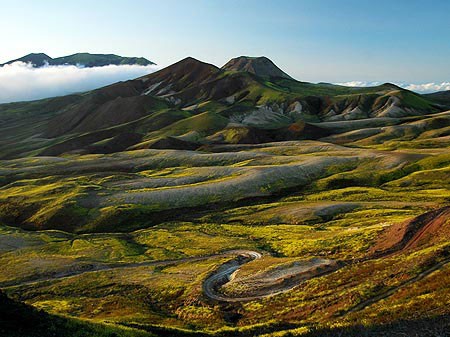
Cape Verde is an archipelago (island chain) of volcanic islands lying 570 kilometres (350 miles) off the West African coast. The ten islands form a crescent; the northern six are known as the Barlavento Islands, while the southern four are called the Sotavento Islands. Many of the islands are mountainous, covered by scrubland. The largest island by both land area and population is Santiago. The smallest, Santa Luzia, which lacks fresh water, is uninhabited. Flat, sandy islands such as Sal and Boa Vista have hot, dry climates, while those with high mountains are more humid—moisture from the ocean forms clouds over the islands’ peaks. Since 2013, Cape Verde has officially been known as the República de Cabo Verde, or Cabo Verde.
People
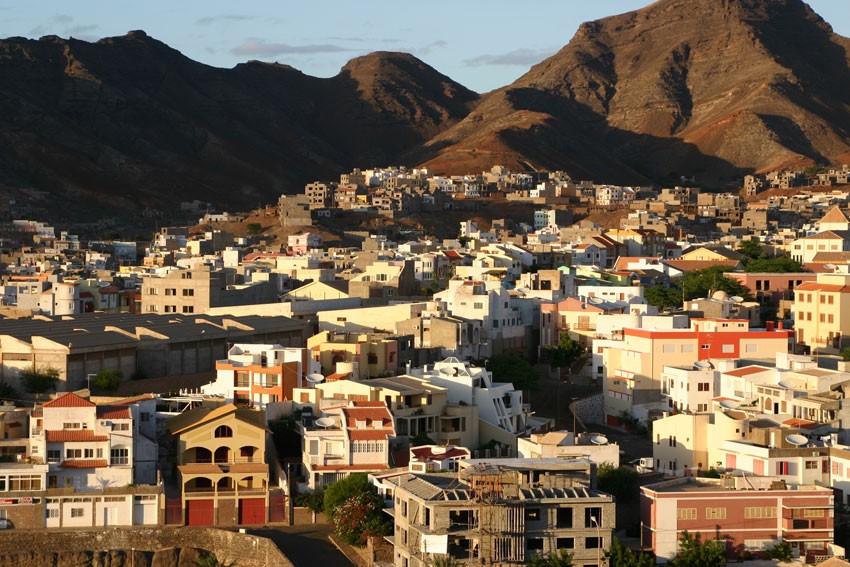
The Portuguese were the first people to discover and colonize the islands; they arrived in the 15th century. Today, Cape Verde is home to just over 500,000 people. Most are of mixed African and European (mainly Portuguese) descent; the rest are ethnically African. They speak a Portuguese creole language called Crioulo as well as Portuguese and are mainly Roman Catholic. About half of the entire population lives on the largest island, Santiago, where the capital, Praia, is situated.
Economy
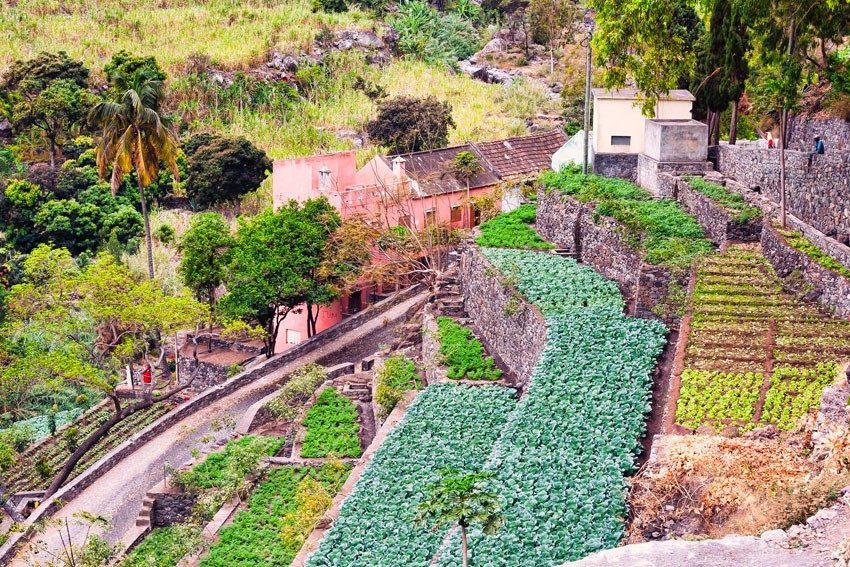
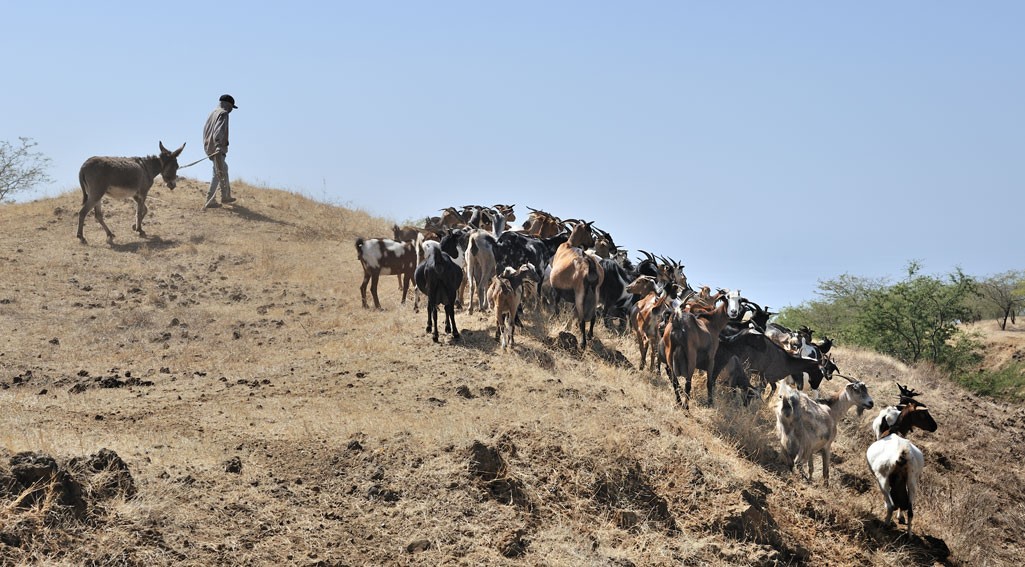
Most Cape Verdeans work in services on the island, running transport and shops and working in the tourist industry—tourism brings in most of the islands’ foreign income. Many people emigrate abroad to study or to find work, sending money back to their relatives in Cape Verde, an important source of income for the islands. Most families have a small plot of land where they grow maize, bananas, potatoes and sweet potatoes. Many also catch fish and shellfish to eat.
Consultant: Nicholas Harris
Facts about Cape Verde
Population 593,149 (2022 census)
Area 4033 sq km
Highest point Pico do Fogo 2829 m (9281 ft)
Capital Praia, population 159,000
Other major cities Mindelo (pop. 70,600)
Languages Portuguese, Crioulo
Religions Christian (Roman Catholic) 77%, other Christian 8%, Muslim 2%, others and none 13%
Ethnicity Creole (mixed European / African) 71%, African 28%, European 1%
Currency Cape Verdean escudo (CVE)
Chief exports fuel, shoes, clothing, fish, animal skins/hides

History of Cape Verde
1456
Portuguese navigators discover the islands
1462
Portuguese build a settlement on the island of Santiago
1495
The islands become a Portuguese crown colony
1500s
The islands are an important stopping-off point on the route of the Atlantic slave trade; they quickly become wealthy
early 1800s
As the slave trade declines, Cape Verde is thrown into economic crisis
1951
Islanders begin to call for independence; Portugal tightens its hold on Cape Verde, making it an overseas province
1956
Amilcar Cabral forms the African Party for the Independence of Guinea and Cape Verde (PAIGC)
1960
PAIGC begins fighting Portuguese army in Guinea-Bissau; many Cape Verdeans join the conflict
1975
Cape Verde becomes independent from Portugal
1991
A new multi-party system of politics is introduced
2007
Cape Verde joins the World Trade Organization (WTO)
2009
Outbreak of dengue fever causes a national emergency
2014
Hundreds of people living on the island of Fogo are evacuated when its largest volcano, the Pico do Fogo, begins to erupt
2024
Cape Verde becomes free of malaria
pics


Without in any way limiting Q-files Ltd’s exclusive rights under copyright, any use of this publication to “train” generative artificial intelligence (AI) technologies to generate text is expressly prohibited. Q-files Ltd reserves all rights to license use of this work for generative AI training and development of machine learning language models.