
Africa

CITE
We have made every effort to follow citation style rules, but there may be some minor differences. If in doubt, please refer to the appropriate citation style manual.
Guinea-Bissau. (2026). In Q-files Encyclopedia, Geography, Africa. Retrieved from
https://www.q-files.com/geography/africa/guinea-bissau
"Guinea-Bissau." Geography, Africa, Q-files Encyclopedia, 30 Mar. 2026.
https://www.q-files.com/geography/africa/guinea-bissau.
Accessed 22 Sep. 2026.
Guinea-Bissau 2026. Geography, Africa. Retrieved 22 September 2026, from
https://www.q-files.com/geography/africa/guinea-bissau
Geography, Africa, s.v. "Guinea-Bissau," accessed September 22, 2026.
https://www.q-files.com/geography/africa/guinea-bissau


Guinea-Bissau
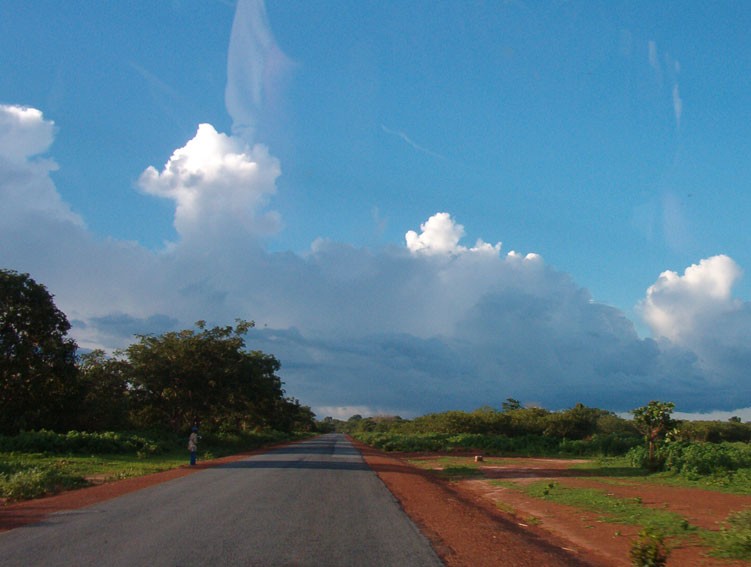
Guinea-Bissau lies on the west coast of Africa, bordering the Atlantic Ocean. Most of the country is flat and covered by savanna grasslands. Its coastline is edged with swampy rivers and mangrove forests. Offshore lies the Bijagos Archipelago, a group of tropical islands with white, sandy beaches and lush palm groves. Guinea-Bissau has a tropical climate with hot, humid weather. It has a wet, rainy season between June and October. During the dry season (between November and March) a cool, dusty wind from the Sahara, called the harmattan, blows over the land.


People
The Balanta people live in the centre and south of the country. The Fulani people, nomadic cattle herders, along with the Mandinka, live mainly in the north and northeast. Both groups are Muslim. Although Portuguese is the country’s official language, only about 1 in 10 people speak it. The rest speak a creole language called Crioulo, based on a mixture of Portuguese and African languages.
Most people in Guinea-Bissau follow a system of religious beliefs called animism; some practise it alongside Christianity or Islam. Animists believe that non-human things such as trees, rocks and rivers have spirits, and pray to them for good luck and protection. Respect for the natural world is very important.


Economy
Guinea-Bissau’s economy is based on farming and fishing. Most of its people work as farmers, growing corn, rice and vegetables for their families on small farms. Many of these farmers also use their land to grow cashew nuts, Guinea-Bissau’s most important crop, for export (the country is one of the world’s largest cashew nut producers). Decades of civil war and unstable government have left Guinea-Bissau one of the poorest countries on Earth and today, it relies heavily on foreign aid.
Consultant: Nicholas Harris
Facts about Guinea-Bissau
Population 2,228,895 (2025 estimate)
Area 28,120 sq km
Highest point unnamed elevation, 310 m (1017 ft)
Capital Bissau, metro area population 664,000
Other major cities Gabú (48,670), Bafatá (pop. 37,985)
Languages Portuguese, Crioulo, Mandinka
Religions Muslim 46%, Folk religions 31%, Christian 19%, other 4%
Ethnicity Balanta 30%, Fulani 20%, Manjaca 14%, Mandinka 13%, Papel 7%, European and others 1%
Currency West African CFA franc (XOF)
Chief exports fish, cashew nuts, shrimp, peanuts, palm kernels, timber

History of Guinea-Bissau
13th century
The area of modern-day Guinea-Bissau comes under the influence of the powerful Mali Empire
1480s
Portuguese explorers, including Diogo Cão, arrive in the region
1537
As the Mali Empire declines, one of its provinces becomes powerful in the region as the Gabu Empire
16th century
Portuguese set up trading posts along the coast, trading West Africans into slavery
19th century
Portuguese begin to explore inland
1879
The region officially becomes a Portuguese colony, called Portuguese Guinea
1951
Portuguese Guinea becomes an overseas province of Portugal
1956
The African Party for the Independence of Guinea and Cape Verde (PAIGC) is set up by Amilcar Cabral
1963–74
War of independence between PAIGC and the Portuguese government
1973
Independence is declared by PAIGC, but is not recognized by Portugal
1974
Following military takeover of the government in Portugal, Portuguese Guinea's independence is recognized globally. The country is renamed Guinea-Bissau. Amical Cabral’s brother Luis becomes the first president
1980
Luis Cabral is removed from power in a military takeover
1994
First free elections are held in the country since independence. João Bernardo Vieira is elected president
1998–99
Guinea-Bissau Civil War. Outbreak of fighting is triggered by an attempted coup d'état against the government of President João Bernardo Vieira led by Brigadier-General Ansumane Mané.
1999
Vieira is removed from power in a military takeover
2000
A new president, Kumba Ialá (Yala), is elected
2003
Military takeover removes Ialá from power
2004
Soldiers mutiny over wages and working conditions, killing the head of the armed forces
2005
Presidential election won by former president Vieira
2009
President Vieira is assassinated by soldiers. Malam Bacai Sanhá is elected president
2011–12
A military coup attempt against President Sanhá, mounted while he is ill in hospital, fails. He dies in 2012, and another coup takes place before a new president is elected and an interim government is formed. UN accuses government members of drug smuggling.
2014
Presidential election won by Jose Mario Vaz, but political crisis continues
2020
Former prime minister Umaro Sissoco Embaló takes wins the presidential election, ending 46 years of rule by the PAIGC or the military
pics
Without in any way limiting Q-files Ltd’s exclusive rights under copyright, any use of this publication to “train” generative artificial intelligence (AI) technologies to generate text is expressly prohibited. Q-files Ltd reserves all rights to license use of this work for generative AI training and development of machine learning language models.