
Africa

CITE
We have made every effort to follow citation style rules, but there may be some minor differences. If in doubt, please refer to the appropriate citation style manual.
Ethiopia. (2026). In Q-files Encyclopedia, Geography, Africa. Retrieved from
https://www.q-files.com/geography/africa/ethiopia
"Ethiopia." Geography, Africa, Q-files Encyclopedia, 30 Mar. 2026.
https://www.q-files.com/geography/africa/ethiopia.
Accessed 22 Sep. 2026.
Ethiopia 2026. Geography, Africa. Retrieved 22 September 2026, from
https://www.q-files.com/geography/africa/ethiopia
Geography, Africa, s.v. "Ethiopia," accessed September 22, 2026.
https://www.q-files.com/geography/africa/ethiopia


Ethiopia
Around 200,000 years ago, Ethiopia, in the Horn of Africa, was home to the earliest known modern humans. Today it is the secondmost populous country in Africa with one of the fastest-growing populations in the world. Much of the country is made up of the Ethiopian Highlands, a region of forested plateaus and steep-sided river valleys. The Great Rift Valley cuts through this area. The climate in the Highlands is warm and humid; most of the country’s farmland and people are found here. East of the Highlands, the land slopes down to dry grassland and desert, where the climate is hot and dry all year round.


People
Ethiopia is home to around 80 ethnic groups and as many languages, although Amharic is the official language. The Amhara live in central Ethiopia, and the Tigray in the north. Together, they make up around a third of Ethiopia’s population. Their languages both come from an ancient Semitic language, Ge’ez, which originated in the Middle East. Ethiopia’s largest ethnic group, the Oromo people, live mainly in the southwest. They speak a Cushitic language (a language group from the Horn of Africa), related to the language of the Somalis in the southeast. In secondary schools, lessons are taught in English.


Developing economy
About 85% of Ethiopia’s population work in agriculture. Frequent droughts and lack of irrigation mean that farming yields are very low. Most people practise subsistence agriculture, growing just enough food to feed their families. Some farmers grow teff, a type of cereal that can be ground into flour to make a pancake called enjera. Families with more money keep a cow or goats.
Ethiopia is one of the world’s major producers of coffee, its biggest export and a key source of foreign income. Most coffee plantations are in the southwestern Highlands. It is thought that the coffee-growing Kaffa region gave its name to the “coffee” we drink today. Ethiopia has a very small manufacturing industry, based around producing foods and drinks, as well as luxury leather goods for export.

Fourteen major rivers run from the Highlands, including the Blue Nile, which meets the White Nile in neighbouring Sudan. Hydro-electric power supplied by these rivers is predicted to be a major source of income in the future.
Danakil Depression


The Danakil Depression is a plain near Ethiopia's border with Eritrea. One of the lowest places on Earth at 100 metres (330 feet) below sea level, it lies in the Afar Triangle, a geological depression sitting at the junction of three tectonic plates. Part of the Great Rift Valley of East Africa, the depression was formed as Africa and Asia moved slowly apart, causing faulting and volcanic activity. The area contains active volcanoes and hot springs. It has also been flooded by the sea, leaving behind a thick coating of salt deposits as the seawater evaporated. Measured by year-round average temperatures, the Danakil Depression, a desert region, is the hottest place on Earth with daytime temperatures exceeding 50°C (122°F). With less than 25 millimetres (1 inch) of rainfall per year, it is also one of the driest.
From the evidence of many fossils of hominins (humans or human ancestors) discovered here, the Danakil Depression is described as the Cradle of Humanity—the place where humans first evolved. The fossilized remains of Australopithecus afarensis (known as Lucy), dated to 3.2 million years old and thought to be an ancestor of modern humans, were uncovered in nearby Hadar in 1974.
Grand Ethiopian Renaissance Dam
The Grand Ethiopian Renaissance Dam (GERD) has been under construction on the Blue Nile, about 15 kilometres (9 miles) from the border with Sudan, since 2011. Its chief purpose is to produce electricity, both to give Ethiopia a stable electricity supply and to export to neighbouring countries. When completed, the dam will be the largest hydro-electric power plant in Africa, and the seventh largest in the world. Filling the reservoir—which is estimated to hold 74 cubic kilometres (17.7 cubic miles) of water—began in July 2020, and was completed in September 2023.

The government of Egypt, hundreds of kilometres downstream from GERD, is concerned that the dam could severely reduce the water supply to its own Aswan Dam and have a devastating effect on its agriculture. Sudan, however, may benefit because the dam will regulate the Nile's flow and lessen the impact of floods during the wet season.

Haile Selassie
Haile Selassie (1892–1975) was Emperor of Abyssinia (as Ethiopia was then called) from 1930 to 1974. In 1935, the Italian army invaded and occupied Abyssinia. The following year, Hailie Selassie appealed to the League of Nations on his country’s behalf, giving a speech that drew admiration from around the world and made him a hero to his people. After his power was restored in 1941, he issued a proclamation giving freedom to the country’s 2–4 million slaves. In 1963, he played an important part in creating the Organization of African Unity. Opinion in the country turned against him in 1974 because of widespread famine and high oil prices. He was deposed by a Communist military junta (a group of army leaders).

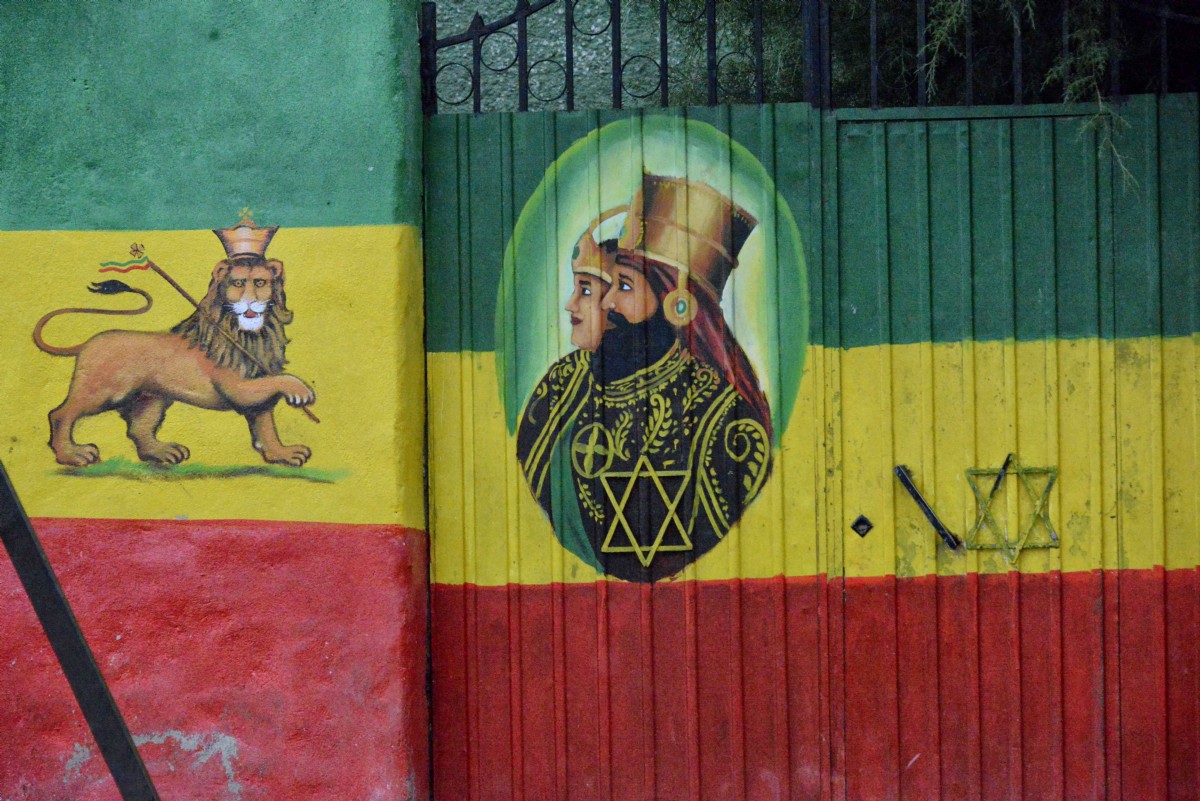
The Rastafari movement began in the Caribbean island of Jamaica in the 1930s. Followers worship Haile Selassie as the messiah (God in human form) who will lead the peoples of Africa to freedom. The movement’s name is taken from Selassie's title (Ras) and first name (Tafari Makonnen) before his coronation. Haile Selassie was an Ethiopian Orthodox Christian, but he was respectful of Rastafari beliefs and did not confirm or deny being the messiah.
Consultant: Nicholas Harris
Facts about Ethiopia
Population 133,988,901 (2025 estimate)
Area 1,128,221 sq km (435,610 sq miles)
Highest point Ras Dashen 4550 m (14,928 ft)
Capital Addis Ababa (metro area population 5,461,000)
Other major cities Mek'ele (Mekelle, 611,574), Dire Dawa (485,558), Gondar (443,156)
Languages Amharic (official language), Oromo, Somali, Tigrinya
Religions Christianity (Ethiopian Orthodox) 44%, Muslim 34%, Christian (Protestant and Catholic) 19%, traditional religions and other 3%
Ethnicity Oromo 35%, Amhara 27%, Somali 6%, Tigray 6%, Sidama 4%, Gurage 3%, Welayta 2%, other 17%
Currency Birr (ETB)
Chief exports Coffee, fruit, vegetables, flowers, leather, live animals, oil seeds, gold


History of Ethiopia
8th century BC
The Kingdom of D’mt is established in northern Ethiopia and Eritrea.
AD 2nd–7th century
The Kingdom of Aksum thrives in northern Ethiopia and Eritrea.
4th century
Emperor Ezana converts to Christianity.
1137–1270
The Zagwe dynasty rules much of the region of modern Ethiopia and Eritrea, establishing a new capital at Adafa.
1181–1221
Reign of King Lalibela, during which eleven rock-hewn churches are built at his capital, then known as Roha (now called Lalileba)
1270–1974
The Solomonic dynasty rules the Ethiopian Empire (Abyssinia).
1508
Emperor Lebna Dengel establishes an alliance with Portugal.
1529
Muslim leader Ahmed Ibn Ibrahim al Ghazi, attacks Abyssinia, destroying its churches and kidnapping its people as slaves.
Mid-1500s
Oromo people move into the area from northern Kenya, challenging Abyssinia.
1888–92
Famine kills nearly a third of Abyssinia’s population.
1889–1913
Emperor Menelik II begins to modernize Abyssinia, founding the city of Addis Ababa as the country’s capital.
1895–96
The First Italo-Abyssinian War: Italian forces invade and are defeated.
1930
Haile Selassie inherits the throne.
1935–36
The Second Italo-Abyssinian War: Italy invades Abyssinia and gains control.
1941
British Empire forces and Abyssinian fighters liberate Abyssinia from Italian control.
1961–1991
Eritrea fights for independence, resulting in an Eritrean victory.
1974
Haile Selassie is deposed by a Communist military junta, called the Derg; the country is renamed the People's Democratic Republic of Ethiopia
1974–1991
The Ethiopian Civil War: rebel groups fight to overthrow the Communist government.
1977
The Ogaden War: Ethiopia fights to regain control of the Ogaden region, captured by Somalia.
1983–85
Severe famine hits northern Ethiopia, killing between 500,000 and 1 million people.
1991
The Communist government of Mengistu Haile Mariam is overthrown.
1993
By popular vote, Eritrea breaks away from Ethiopia to form an independent state.
1995
Ethiopia’s first multi-party election is held.
1998–2000
Border dispute with Eritrea sparks the Eritrean–Ethiopian War
2011
Worst drought in East Africa for 60 years
2016
Protests breaking out across the country demanding an end to human rights abuses are violently put down by the government
2018
Abiy Ahmed becomes prime minister (April). The country's first Oromo leader, he introduces reforms including the lifting of the state of emergency, ordering the release of thousands of political prisoners, agreeing to accept a ruling that gives disputed territory to Eritrea and declaring an end of the war between the two countries
2018
(October) Ethiopia's parliament appoints the country's first female president, Sahle-Work Zewde
2019
The Nobel Peace Prize is awarded to Abiy Ahmed "for his efforts to achieve peace and international cooperation, and in particular for his decisive initiative to resolve the border conflict with neighbouring Eritrea."
2020
(November) Conflict breaks out in Tigray, the northernmost region of Ethiopia. The Tigray War is fought between the federal government and the Tigrayan People's Liberation Front (TPLF), after the government declares that due to the Covid-19 pandemic, it would postpone elections.
2022
(November) Following a number of peace proposals made since the Tigray War began, the Ethiopian government and the Tigrayan rebel forces agree to a permanent ceasefire. Under the terms of the deal, brokered by the African Union, Tigrayan forces will disarm and the government will allow humanitarian acess to the region. An estimated 385,000–600,000 people have been killed during the war and famine has been widespread.
2023 (April) onwards
(April) War in Amhara: Ethiopian government forces (ENDF) attempt to disarm the Amhara Special Forces (Fano), leading to resistance of local armed forces and triggering protests many cities. Clashes erupt between the Fano militia and the ENDF in Debre Tabor, Gondar, Kobo, Debre Birhan and Shewa Robit.
2024 (January)
An agreement is signed between Ethiopia and the breakaway government of Somaliland, granting Ethiopia the right to lease the port of Berbera for 50 years in exchange for recognition of Somaliland as an independent state. Somalia opposes this agreement.
2024 (July)
Landslides bury two villages in the Gofa region, killing 257 people. The second landslide buried those who had arrived to help rescue people from the first. They are the deadliest landslides in Ethiopian history.
pics


Without in any way limiting Q-files Ltd’s exclusive rights under copyright, any use of this publication to “train” generative artificial intelligence (AI) technologies to generate text is expressly prohibited. Q-files Ltd reserves all rights to license use of this work for generative AI training and development of machine learning language models.