
Africa
Namibia
Lying on Africa’s southwest coast is Namibia, one of the least densely-populated countries in the world. Most of the land is hot, dry desert and completely uninhabited. Running down Namibia’s western coast is the Namib Desert, one of the driest places on Earth. Inland, a range of high, craggy mountains rise sharply from the desert plains. The rest of the country lies on a high, semi-desert plateau; its land is a mixture of scrubland and savanna. In the east, this region merges with the Kalahari Desert. Namibia’s climate is subtropical, with very hot summers and warm winters. There is very little rain. The capital, Windhoek, lies high in the mountains, where conditions are slightly cooler all year round.


People
Most Namibians are descended from the Bantu peoples who spread out from central Africa 3000 years ago. Today, there are 16 different ethnic groups or “tribes” in Namibia; the largest group, the Ovambo, make up 50% of the population. Many groups speak different languages but most people can speak Afrikaans or English to communicate with one another. Nearly all Namibian children go to school, which means that the country has one of the highest literacy rates (the proportion who can read and write) in sub-Saharan Africa. About 2% of the population is of European—Afrikaner, German English or Portuguese—descent.

Himba
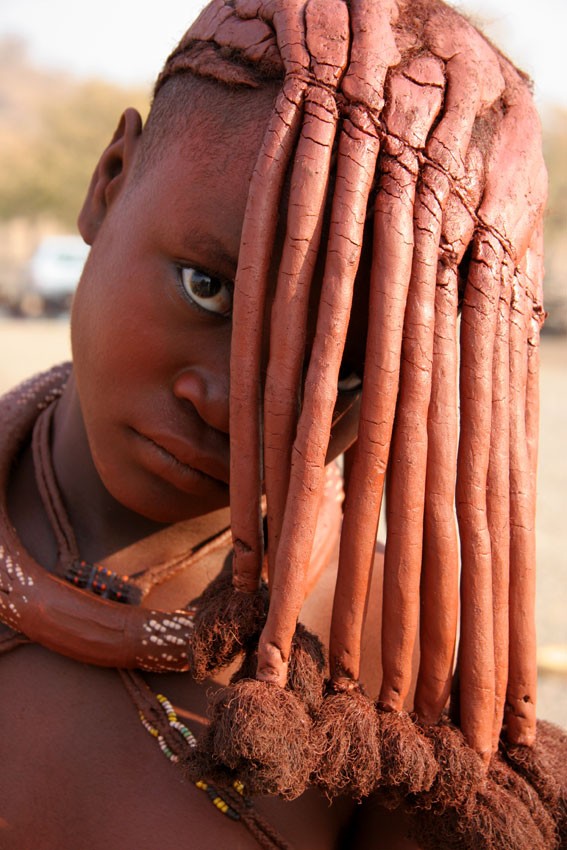
Namibia’s Himba people are semi-nomadic farmers who herd cattle and goats across the Kaokoland, an area of dry northern plains. They measure their wealth by the number of cattle they own. In Himba villages, women and girls are builders, building and maintaining the family home. They also milk the cows, collect water, cook and make jewellery. Men and older boys look after the animals; they are sometimes away herding for weeks at a time. The Himba have distinctive hairstyles: people wear different braids or styles to show that they are married, have had a child, or even that they are one of twins.


Mining
Mining is Namibia’s largest industry. The country is one of the world’s largest producers of uranium, used to fuel nuclear power stations. Namibia also supplies almost one-third of the world’s diamonds; known as “alluvial diamonds”, they are found in the beds and valleys of old rivers that have dried up. Although many mining companies in Namibia are foreign-owned, the industry still brings in about half of the country’s entire export earnings.

Farming
Only a very small number of people work in mining; most Namibians are farmers. People in the centre and north of the country raise cattle and goats and grow crops such as millet and sorghum to feed themselves and their families. In the south, many people are employed on large commercial ranches, tending cattle and sheep.


Namib Desert
The Namib Desert stretches for more than 2000 kilometres (1200 miles) along Namibia’s Atlantic coast, reaching into South Africa in the south and Angola in the north. Its name, Namib, means “vast place” in the local Nama language. Near the coast, the desert landscape is made up of rolling sand dunes and flat “sand seas” similar to those found on Mars. Some of the dunes soar more than 300 metres (980 feet) tall: they are the highest coastal sand dunes in the world. Few animals and plants can survive here. Often, a thick fog rolls in from the ocean, providing moisture for desert shrubs, small animals and insects.
Consultant: Nicholas Harris
Facts about Namibia
Population 3,092,816 (2023 census)
Area 823,290 sq km
Highest point Brandberg 2606 m (8550 ft)
Capital Windhoek, population 486,169
Other major cities Rundu (118,625), Walvis Bay (102,704), Swakopmund (75,921)
Languages Oshiwambo, Nama / Damara, Otjiherero and Kavango languages, Afrikaans, English
Religions Christian 88%, indigenous beliefs 10%, other 2%
Ethnicity Ovambo 50%, Kavango 9%, Herero 7%, Damara 7%, Nama 5%, Caprivian 4%, San 3%, others 5%
Currency Namibian dollar (NAD)
Chief exports diamonds, copper, gold, zinc, lead, uranium, fish, molluscs, cattle, meat


History of Namibia
1300s
The region is settled by Bantu peoples from central Africa
1488
Portuguese explorer Bartolomeu Dias visits the region
1870s
Gottlieb Viehe, a German missionary, translates the Christian New Testament into the Herero language
1884
Germany claims the region as a colony, naming it German South West Africa (Deutsch-Südwestafrika in German)
1890
The Caprivi Strip is annexed to German South West Africa, as part of a deal in which Britain assumes control of the island of Zanzibar in East Africa
1894
Armed uprising by the Nama people is suppressed by the Germans
1904–07
Herero and Nama peoples rebel against the German colonial rulers. In response, around 50% of the Nama population (10,000 people) and 80% of Herero (65,000 people) are killed by German troops in what will later be called the Herrero-Nama Genocide (mass killings of entire peoples)
1915
During World War I, South Africa occupies the colony
1919
South Africa begins ruling the region on behalf of the League of Nations
1946
South Africa refuses to hand control of the region over to the United Nations
1958–60
A new political party, the South West Africa People’s Organization (Swapo), calling for independence, is set up
1966
Swapo begins fighting against South African occupation
1968
United Nations declares South Africa’s occupation of the country illegal and renames it Namibia
1988
South Africa agrees to grant Namibia independence if Cuban troops pull out of Angola
1990
Namibia becomes independent with Sam Nujoma as president
1999
Violence flares up in the Caprivi Strip (northeastern Namibia) following attacks by people who want it to become a separate state
2004
Germany formally apologizes to Namibia for the Herrero-Nama Genocide of 1904–07
2011
An estimated 11 billion barrels of oil is discovered offshore in Namibia
2024
President Hage Geingob dies and is succeeded by vice-president Nangolo Mbumba